

On 1 July 2026, a panel of 40 experts convened by the United Nations published its first assessment of artificial intelligence. The preliminary report of the Independent International Scientific Panel on AI names an evidence dilemma. Policymakers, it says, "need evidence to make informed consequential governance decisions, but by the time the evidence exists, it might be too late to make them". Days later, governments discussed it in Geneva at the first UN Global Dialogue on AI Governance.
Andrei Baciu brought a proposal of his own to Geneva. A cardiovascular surgeon trained in Bucharest and at Rouen University Hospital in France, and a former secretary of state at Romania's Ministry of Health, he has sat in the Chamber of Deputies since December 2024. In February 2026 he proposed Romania's first parliamentary committee on AI. Interviewed for Tech Anatomy in Bucharest, he took the evidence dilemma as the starting point for a practical question: what should health systems and their regulators do while the evidence is incomplete?
Acting on incomplete evidence
Medicine calls itself evidence-based, which suggests nothing happens without years of trials. Baciu reads the term differently: not leaving a technology unused until the proof is complete, but choosing to "use the best evidence available and keep on monitoring". His example is a car crash victim: the surgical team does not know everything the body has suffered, and still operates, guided by protocols and checklists.
The obvious objection is that an emergency forces a decision, while a patient can usually be treated correctly without AI. Baciu did not dispute this. He moved the analogy to the legislator, whom he compares to an ambulance driver: reach the hospital before the patient deteriorates, keep everyone on the road safe, and "from time to time, maybe you have to cross a red light."
He also pointed to an existing rule: Article 22 of the EU General Data Protection Regulation, which protects people from decisions with legal or similarly significant effects taken solely by automated processing, such as an automated CV screen, and lets them obtain human review and contest the outcome. Baciu said the same applies in the UK. That held until 5 February 2026, when the UK replaced Article 22 with provisions that permit solely automated decisions in more situations, with safeguards and tighter limits for sensitive data such as health information.
How a payer tells value from hype
Baciu says that "for some months" he was president of Romania's national health insurance fund, the public payer. There, he says, the inbox fills with AI proposals, and the work is to find value within a "globally spread hype". His method is a baseline, then a pilot, then "very strict KPIs" defining success.
The harder part is defining value. Take an AI scribe, software that listens to a consultation and drafts the clinical note. Suppose it saves a doctor one hour a week. "Are you going to see five more patients?" he asks, or spend five more minutes with each patient already booked. If the hour becomes more volume, he argues, the gain is commercial rather than clinical, which makes the choice an ethical one before a technical one. Cost belongs in the same calculation: "You can buy new medicine with that money."
The deskilling question
Asked whether younger doctors who rely on AI tools may never build their own clinical judgement, a worry heard among cardiologists, Baciu answered with surgery. A resident learning lung surgery should master the open procedure before operating with a robot, because "we do have to make sure that we know how to perform our duties without AI." He drew the same lesson from aviation: when the automation fails, the pilot has to take over at full standard.
The colonoscopy study he cited is worth describing precisely. Budzyń and colleagues, in The Lancet Gastroenterology & Hepatology in 2025, looked at four Polish endoscopy centres that introduced AI for polyp detection at the end of 2021. Rather than two groups of doctors, they compared unassisted colonoscopies in the three months before and after AI arrived. In those procedures, the adenoma detection rate fell from 28.4% to 22.4%: six percentage points in absolute terms, about a fifth in relative terms. The design is retrospective and observational, and the authors concluded only that continuous exposure to AI "might" reduce detection without it.
Two readings of slow institutions
Baciu partly agreed with the statement that no parliament will ever legislate on AI fast enough. Institutions, he said, still function in a "pre-AI velocity era", and they lack expertise of their own: "Most of the AI expertise is within academics or private environment, not within public environment." The UN report makes a similar observation, that most countries, "including many advanced economies, lack the technical expertise to assess the most capable 'frontier' models".
In his reading, capacity is the bottleneck, built in stages: literacy, then fluency, then experts on staff, the way electricity needed a grid before anyone could flip a switch. A parliamentary AI committee would house that expertise, and a network of lawmakers across countries would let a law that works in one place be adapted elsewhere instead of drafted from scratch.
The other reading starts from the companies. Startups need funding and products now, and capacity-building moves more slowly than the models. On that view, the cost of waiting falls on those building the tools. Baciu's answer placed the responsibility on leadership, down to the doctor who asks a chatbot about a treatment outside their specialty and needs to know the answer reflects the model's training data, which may say little about local diseases.
One point drew no hedging. Should doctors be legally required to tell patients whenever an algorithm took part in a decision? He agreed entirely: "It's transparency that builds trust. It's nothing else."
What the interview does not establish
This is one legislator's view, not a review of the evidence on AI in health. The UN report he draws on is preliminary; the panel's next report is due before the second Global Dialogue, in New York in May 2027. The colonoscopy data cover one specialty and 1,443 procedures, in a design that cannot exclude other explanations. And the parliamentary committee remains a proposal: Romanian press reports from October 2026 describe it as formally submitted, with a UN and UNDP training for members of Parliament scheduled for 10 to 12 November as a first step. No vote creating the committee has been reported.
What to watch
Some markers will show whether "keep on monitoring" becomes practice. One is whether Romania's committee is created, and with what powers. Another is the national law that would let ANCOM, named by government memorandum in March 2026 to supervise the EU AI Act in Romania, investigate and sanction; in July 2026 it was still being drafted. A third is the transposition, due by 9 December 2026, of the revised EU Product Liability Directive, which brings software within its scope and will shape who answers for harm when an AI-assisted decision goes wrong. And in each hospital that deploys an AI scribe, Baciu's question stays open: whether the hour it saves goes to more patients, or to the ones already in the room.
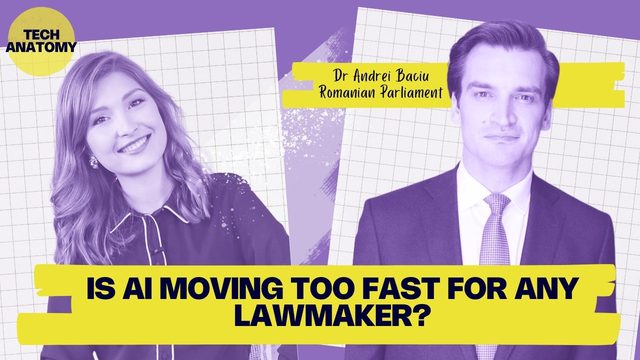
AI moves faster than the law: the evidence dilemma - Dr Andrei Baciu, Romanian Parliament
Listen · 29 minSources
- Interview with Dr Andrei Baciu, cardiovascular surgeon and member of the Romanian Chamber of Deputies. Recorded for Tech Anatomy in Bucharest, published 6 October 2026.
- Preliminary Report of the Independent International Scientific Panel on AI: Evidence-based assessment of opportunities, risks and impacts of AI, United Nations, 1 July 2026
- Global Dialogue on AI Governance, United Nations; first session, Geneva, 6-7 July 2026, ITU media advisory
- Budzyń K et al. Endoscopist deskilling risk after exposure to artificial intelligence in colonoscopy: a multicentre, observational study, Lancet Gastroenterol Hepatol. 2025;10:896-903
- Regulation (EU) 2016/679, General Data Protection Regulation, Article 22, EUR-Lex
- Data (Use and Access) Act 2025, section 80, automated decision-making, legislation.gov.uk
- Andrei Baciu on EU member states' measures on artificial intelligence, Factual.ro (in Romanian)
- Three days with UN experts: what Romanian MPs will learn about AI risks and regulation, Mediafax, 8 October 2026 (in Romanian)
- Government memorandum on national competent authorities for the AI Act, 12 March 2026, ANCOM (in Romanian)
- ANCOM on the application of the EU AI Act in Romania, Economica.net, 24 July 2026 (in Romanian)
- Directive (EU) 2024/2853 on liability for defective products, EUR-Lex

