
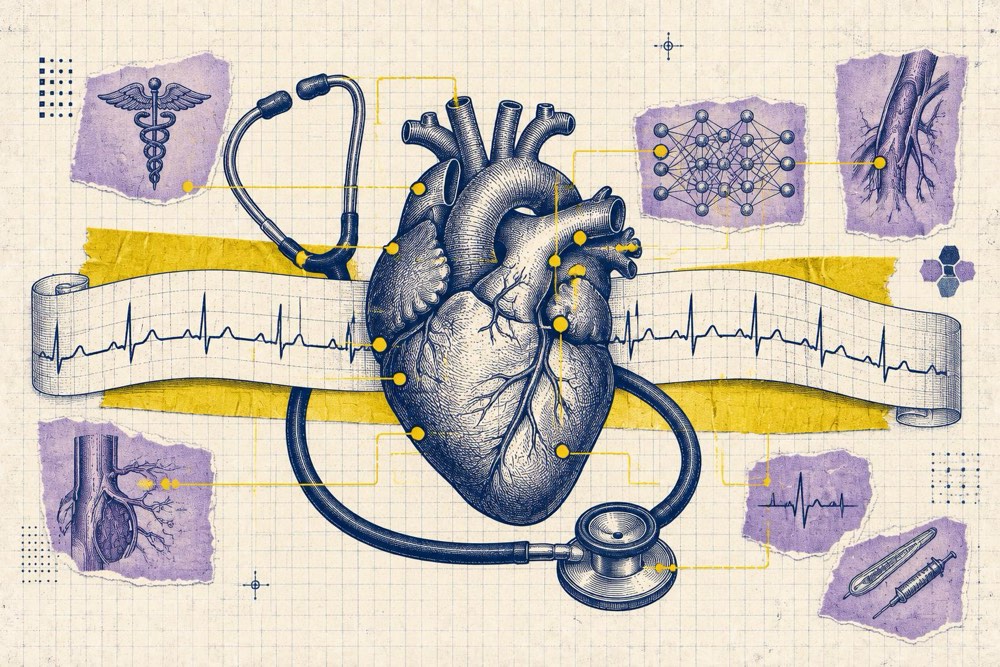
A standard electrocardiogram, or ECG, records the heart's electrical activity through twelve views, called leads, over ten seconds. Most ECG machines print a computer-generated interpretation at the top of the page. Benedict Glover, a consultant cardiologist and cardiac electrophysiologist at the Mater Private Network in Dublin, tells his students to ignore it. The algorithms behind those printouts belong to a tradition of computerised ECG reading that began in research labs around 1960 and reached hospitals in the early 1970s. "That algorithm is actually over 50 years old," he said in an interview for Tech Anatomy in August 2026.
Electrophysiology, the subspecialty that treats heart rhythm disorders, often through catheters threaded into the heart, produces some of the densest data in medicine. Wearable monitors known as Holters can record continuously for up to 14 days, and during an ablation procedure his team may record "30,000, 40,000 points" of electrical activity inside the heart. In both settings, he says, AI already sorts patterns for a physician who confirms or rejects them, and in the lab it helps locate rhythm problems and shortens procedures.
What the ECG studies measured
Can a model see what a trained eye cannot? Glover describes the tracing as "like a massive Excel spreadsheet": the waves a cardiologist reads are a sum of many underlying electrical signals, and a model can work on the raw values.
The best-known evidence comes from Mayo Clinic in the United States. In a study published in Nature Medicine in January 2019, a neural network trained on paired ECGs and echocardiograms from 44,959 Mayo Clinic patients was tested on 52,870 others. It identified a low ejection fraction, the measure of how much blood the left ventricle pumps out with each beat, normally obtained by ultrasound, with an area under the curve of 0.93 and an accuracy of 85.7 percent. A second Mayo study, in Circulation: Arrhythmia and Electrophysiology the same year, trained a network on ECGs from about 500,000 patients and tested it on 275,000 more: it predicted sex with 90.4 percent accuracy and estimated age to within about seven years on average. A third, in The Lancet in August 2019, found signs that a patient had atrial fibrillation, an irregular rhythm linked to stroke, in ECGs recorded while the heart was beating normally.
In the episode, Glover placed the ejection fraction work in a South Korean cohort of more than a million patients. The Mayo studies used Mayo's own patient records. Researchers in South Korea published separate models, including one from Mediplex Sejong Hospital in 2019 that detected heart failure with reduced ejection fraction from ECGs of about 22,800 patients.
The Mayo low ejection fraction algorithm has since left the lab. Anumana, a company created with Mayo Clinic, obtained FDA 510(k) clearance for it in October 2023.
From a risk score to a clinical decision
Glover sees the main change in primary prevention, the work of stopping disease before it starts. A model that reads a normal ECG and returns a probability of future atrial fibrillation or heart failure gives a physician a reason to act earlier. He frames the dilemma himself: "If I say to you, you know, you've got a 70% chance of atrial fibrillation, is that helpful or is that stressful?" His answer is that it helps, because it can prompt changes in diet, exercise or medication.
His advice on trust starts from scepticism. "Be sceptical of everything," he says, and he describes the good clinician as a detective who keeps a differential diagnosis open. What concerns him most is the kind of error AI makes. "When it's wrong, it's not grossly wrong. It's very close to the truth," he says. "It's very hard to spot something that's very close to being true."
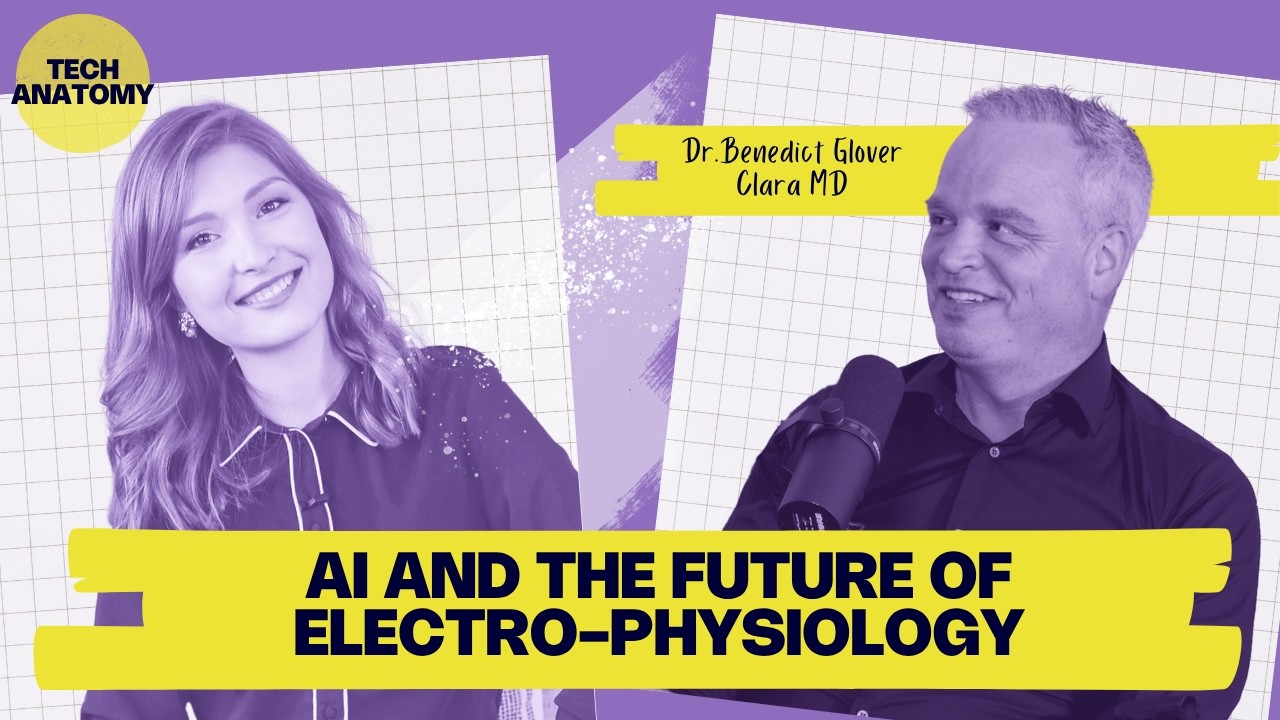
He applies the same caution to his own tool. Glover has built an app, presented in the episode title as Clara MD, for patients, clinicians and students. He did not name it on air. As he describes it, it scores medical publications against criteria such as study design and potential bias, admits only those above a threshold, and combines them with guidelines, patient experiences and the opinions of senior clinicians, including retired ones. A Google Play listing under his name, published by MetamedMD in Ireland, describes an app called CLARA (Clinical AI Recovery Assistant) as a patient health assistant that also reads smartwatch vitals, and states that it is not a medical device. He says local authorities have accepted the app as an educational tool, and that turning it into a medical device would require randomised studies. Under the EU Medical Device Regulation, software that supplies information used for diagnostic or therapeutic decisions generally falls into class IIa or higher. He calls the situation "absurd in some regards, because all of the large language models which patients are using to get advice, none of them are medical devices."
Two readings of the same evidence
One reading holds that the retrospective results are strong enough to change practice now. The signals are large, the datasets are big, an algorithm has regulatory clearance, and the cost of a missed weak heart is high. Glover leans this way on wearables: he asks patients to record an ECG on their Apple Watch during a consultation and argues that health systems should weigh devices costing a few hundred euros against implantable loop recorders that cost several thousand. Apple's ECG app received its FDA De Novo authorisation in September 2018. He also runs a virtual clinic in Ireland where patients who would otherwise be admitted stay home with ECG, blood pressure and oxygen monitoring and report their readings twice a day.
The other reading holds that detection is not the same as benefit. Glover makes this point himself when asked about radiology, where AI has sped up image reading. Whether faster or more accurate diagnosis improves outcomes is, in his words, "to be studied", and he adds that "we're lagging behind in research." He wants that research led by physicians, arguing that "tech companies don't really know what the problem is."
What the evidence does not yet establish
The ECG studies above are retrospective: they test whether a model reproduces a diagnosis already present in the records, mostly from a single health system. The one large randomised trial of the Mayo low ejection fraction algorithm, EAGLE, published in Nature Medicine in 2021, involved 22,641 patients and 120 primary care teams. New diagnoses of low ejection fraction within 90 days rose from 1.6 to 2.1 percent when clinicians saw the AI result. The trial measured diagnosis, not survival or hospital admissions.
Some statements rest on Glover's own experience. The savings and patient satisfaction he reports for his virtual clinic, and his comparison of his app's performance with his own ("not as good as me, I have to say, but it's pretty close"), are observations, not published evaluations. Tech Anatomy could not independently review how his app scores publications.
What to watch
Glover's line that "physicians who embrace artificial intelligence will replace physicians who don't" describes a direction, not a measured effect. The indicators that would test it are prospective trials that follow AI-ECG screening through to hard outcomes such as hospital admissions for heart failure or strokes, external validation of these models outside the populations that trained them, and the regulatory path chosen by clinician-built tools such as his. Whether an educational app that ranks evidence can show, in a randomised study, that it changes decisions for the better is the question his own next step is designed to answer.
Sources
- Tech Anatomy, AI and the Future of Cardiology, interview with Dr Benedict Glover, published 4 August 2026.
- Dr Benedict Glover, consultant profile, Mater Private Network
- Attia ZI et al. Screening for cardiac contractile dysfunction using an artificial intelligence-enabled electrocardiogram. Nat Med. 2019;25:70-74.
- Attia ZI et al. Age and sex estimation using artificial intelligence from standard 12-lead ECGs. Circ Arrhythm Electrophysiol. 2019;12:e007284.
- Attia ZI et al. An artificial intelligence-enabled ECG algorithm for the identification of patients with atrial fibrillation during sinus rhythm. Lancet. 2019;394:861-867.
- Kwon JM et al. Development and validation of deep-learning algorithm for electrocardiography-based heart failure identification. Korean Circ J. 2019;49:629-639.
- Yao X et al. Artificial intelligence-enabled electrocardiograms for identification of patients with low ejection fraction: a pragmatic, randomized clinical trial. Nat Med. 2021;27:815-819.
- Anumana receives US FDA 510(k) clearance for ECG-AI algorithm to detect low ejection fraction, BioSpace, October 2023
- Rautaharju PM. Eyewitness to history: landmarks in the development of computerized electrocardiography. J Electrocardiol. 2016;49:1-6.
- De Novo classification request, ECG App, DEN180044, US Food and Drug Administration, September 2018
- MDCG 2019-11, Qualification and classification of software under the MDR and IVDR, explained, OpenRegulatory