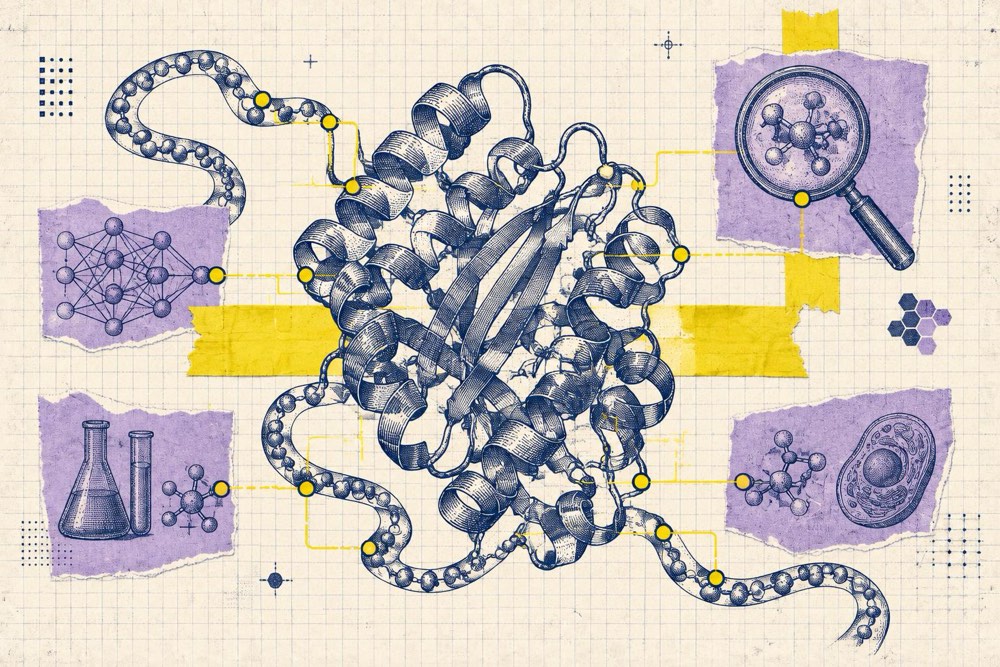
Proteins do most of the work in a living body. They digest food, carry oxygen, repair tissue and recognise viruses. Each one starts as a chain of building blocks called amino acids, and it only works once that chain has folded into a precise three-dimensional shape. The shape decides what the protein can bind to, which is also why it matters to anyone designing a drug.
For about fifty years, working out that shape from the amino acid sequence alone was one of the standing problems of biology. The number of possible configurations is astronomically large, so trying them one by one is not an option. The reliable alternatives were laboratory methods such as X-ray crystallography and cryo-electron microscopy, which can take months or years for a single protein and do not work for every one.
In 2020, a system built by DeepMind, the London AI laboratory owned by Google since 2014, produced predictions that matched experimental results closely enough to change how the field works. In October 2024, Demis Hassabis and John Jumper of Google DeepMind received half of the Nobel Prize in Chemistry "for protein structure prediction". The other half went to David Baker of the University of Washington for computational protein design.
How the problem was measured
Progress on structure prediction has been tracked since 1994 by CASP, the Critical Assessment of protein Structure Prediction. Every two years, teams receive sequences of proteins whose structures have just been determined in a laboratory but not yet published, and submit their predictions. It is a blind test, which makes it hard to flatter a method.
DeepMind entered the 2018 edition, CASP13, with a first version of AlphaFold and ranked first. That system predicted the distances between pairs of amino acids, a kind of heat map, then used physics-inspired optimisation to build a 3D model consistent with those distances. At CASP14 in 2020, AlphaFold 2 reached a median score of 92.4 on the GDT scale, which runs from 0 to 100. A score of around 90 is informally considered competitive with experimental methods.
What changed in the second version
AlphaFold is not trained by trial and error, as DeepMind's game-playing systems were. It uses supervised learning: it learned from known protein sequences paired with their experimentally determined structures. It also draws on evolutionary information. When the same protein is compared across many species, positions that tend to mutate together are likely to sit close to each other in the folded shape, because a change in one needs a compensating change in the other.
The second version replaced the two-step approach with a single network that reasons about the sequence, the evolutionary comparisons and the emerging 3D structure at the same time, refining its estimate over several passes. Part of that network is built on attention mechanisms, the same family of techniques used in the large language models behind chatbots.
Distribution followed. In July 2021, DeepMind and EMBL's European Bioinformatics Institute released predicted structures for the human proteome. A year later, the open database grew to more than 200 million predicted structures, covering almost every catalogued protein. A structure that once required a laboratory project can now be looked up.
Two ways to read the result
One reading sees AlphaFold as a change in how the life sciences work. Structural information that used to be scarce and expensive is now abundant and free, which lowers the cost of forming hypotheses about disease mechanisms, enzymes and drug targets, and gives small laboratories the same starting point as large ones. The Nobel committee's framing, a 50-year problem addressed, supports this view.
A second reading is more cautious about what this means for medicine specifically. Knowing a target's static shape is one step in a long sequence. A drug candidate still has to bind selectively, reach the right tissue, avoid toxicity and show a benefit in clinical trials, and those later stages are where most programmes stop. A 2019 analysis in Biostatistics, covering more than 21,000 compounds, estimated that about 14 percent of drug development programmes entering clinical trials reach approval. Structure prediction offers less help at those stages. In this view, AlphaFold removed a real bottleneck, but not the one that decides most drug programmes.
The two readings are not mutually exclusive. They differ mainly on which step of the pipeline is considered the binding constraint, and that differs from one therapeutic area and one target to another.
What predicted structures do not capture
AlphaFold predicts a likely shape with a confidence score for each region. Several limits are acknowledged by its developers and users. Some proteins have no single fixed structure, and parts of them remain disordered or flexible, which a static model cannot fully represent. Proteins often act in complexes, and the original version was less reliable on assemblies of several chains. And a prediction is still a prediction: for many uses it is a hypothesis to be confirmed experimentally, not a substitute for the experiment.
When the Tech Anatomy episode on AlphaFold was recorded, modelling how proteins interact with small molecules such as drugs was described as the next frontier. That work had in fact already started. AlphaFold 3, published in Nature in May 2024 by Google DeepMind and its sister company Isomorphic Labs, predicts joint structures of proteins with DNA, RNA, ions and small molecules, and its authors report substantially higher accuracy on protein-ligand interactions than standard docking tools.
What would show the effect on medicine
The scientific milestone is documented. Its clinical effect is harder to measure, because drug development takes a decade or more and any single tool is one input among many. The indicators worth following are whether drug candidates whose design relied heavily on predicted structures reach clinical trials and succeed there at different rates, whether interaction models such as AlphaFold 3 hold up when tested independently on new targets, and whether open access to these tools stays as broad as it was for the structure database. Each of those will take years to settle.
Sources
- Tech Anatomy solo episode, The Incredible Story of AlphaFold, published 17 June 2025.
- Jumper J et al. Highly accurate protein structure prediction with AlphaFold, Nature, 2021;596:583-589
- Senior AW et al. Improved protein structure prediction using potentials from deep learning, Nature, 2020;577:706-710
- Protein Structure Prediction Center, CASP experiments since 1994
- Wong CH, Siah KW, Lo AW. Estimation of clinical trial success rates and related parameters, Biostatistics, 2019;20:273-286
- Jumper J et al. Applying and improving AlphaFold at CASP14, Proteins, 2021
- New AlphaFold DB release with 200+ million predicted structures, EMBL-EBI, July 2022
- Abramson J et al. Accurate structure prediction of biomolecular interactions with AlphaFold 3, Nature, 2024;630:493-500
- The Nobel Prize in Chemistry 2024, Royal Swedish Academy of Sciences