
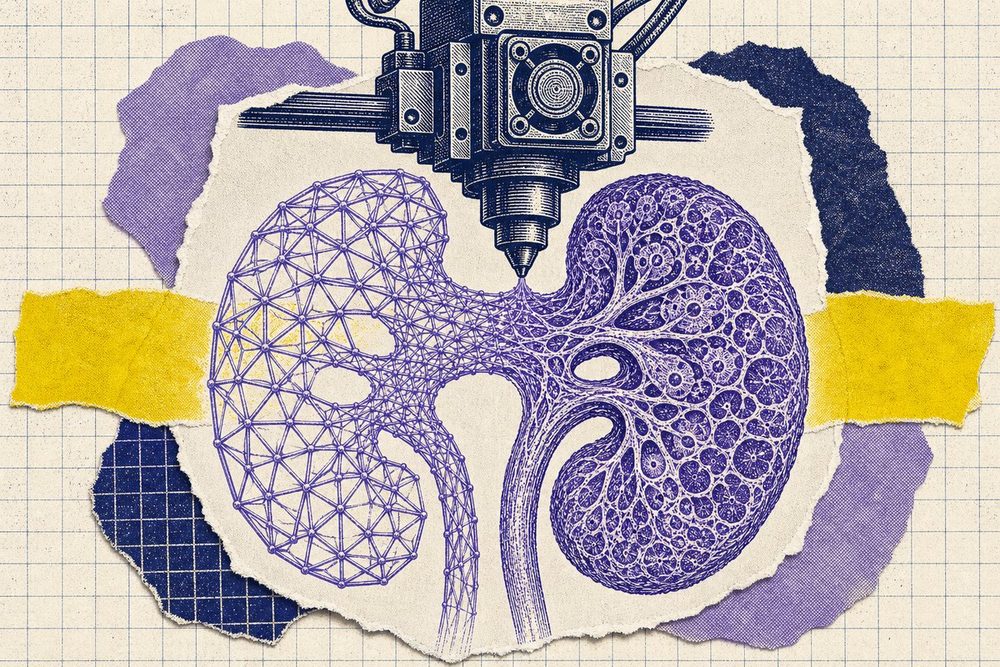
In November 2014, Organovo announced the commercial release of exVive3D, a bioprinted human liver tissue intended for preclinical drug testing. It was not a liver but a small sample combining three cell types found in the organ, including hepatocytes, the cells that do most of its metabolic work. According to the company, the tissue stayed functional for at least 42 days. A study published in PLOS ONE in 2016 reported that these tissues responded to drugs known to damage the human liver in ways consistent with clinical experience.
Bioprinting, the use of 3D printing to place living cells into organised structures, had produced something real enough to sell. Twelve years later, no printed heart, kidney or whole liver has been transplanted into a human being. The distance between those two facts is the subject of a French-language episode of Tech Anatomy's ERROR 404 series, and most of it comes down to blood supply.
Where the idea came from
In the early 2000s, at Clemson University, Thomas Boland's team modified commercial inkjet printers to dispense protein and cell solutions instead of ink, work published in 2003 and later patented. At the University of Missouri, the physicist Gabor Forgacs studied how cells left to themselves organise into tissue and how small cell aggregates fuse. The two men co-authored, with Vladimir Mironov and others, a 2003 paper in Trends in Biotechnology describing "organ printing" as computer-aided, jet-based tissue engineering.
Forgacs's work became the scientific basis of Organovo, incorporated in Delaware in 2007. The company became public in 2012 through a reverse merger, before listing on a national exchange in 2013. The stated ambition was functional human tissue first and organs eventually, an answer to the shortage of donor organs that would, in principle, also avoid rejection.
Anthony Atala, at the Wake Forest Institute for Regenerative Medicine, had reported in The Lancet in 2006 on seven young patients given bladders engineered from their own cells. On the TED stage in March 2011, he showed a printer producing a kidney-shaped structure. It was a demonstration of form, not a transplantable organ, a distinction the episode places at the centre of the story. In 2016, his team described in Nature Biotechnology a system called ITOP that printed human-scale ear, bone and muscle constructs with microchannels to let nutrients reach the cells inside.
How tissue is printed
The material is a bioink: living cells suspended in a hydrogel, a water-based gel that mimics the cells' natural surroundings and holds them in place while they are deposited. A digital model defines the structure layer by layer, and the printer deposits the bioink by extrusion, inkjet or laser-assisted methods, each trading speed against precision and cell survival. A scaffold often holds the shape, and the printed piece then matures in a bioreactor until the cells start to behave like tissue.
In the episode's assessment, printing the shape has become close to feasible; keeping the tissue alive in depth has not.
The vascularisation problem
Cells depend on oxygen and nutrients carried by blood. A thin layer of tissue can survive by diffusion from its edges, but beyond a fraction of a millimetre the cells at the centre are cut off and die. The episode compares it to watering a garden: a narrow strip of lawn gets enough water from the sides, while a large, dense plot needs pipes running through it. A thick organ needs a branching network of vessels down to the capillaries, connected to the circulation. A 2022 review in the International Journal of Molecular Sciences describes this as the central obstacle for dense tissues such as liver and kidney.
In August 2019, after reviewing its therapeutic liver tissue programme, Organovo's board concluded that "the variability of biological performance and related duration of potential benefits presented development challenges", with long redevelopment timelines, according to the company's quarterly filing. It suspended the programme and let go of 46 employees, 79% of its workforce. The episode adds an economic constraint: tissue for drug testing was a real market, but a narrow one.
What has reached patients
In June 2022, 3DBio Therapeutics announced the first implant of AuriNovo, an ear printed from a patient's own cartilage cells, in a 20-year-old woman born with microtia, a malformation of the outer ear. The episode explains the choice of organ: ear cartilage is thin and has little blood supply, so the vascularisation barrier matters far less. The trial was designed for eleven patients. According to ClinicalTrials.gov, it was terminated in May 2023 after enrolling two, for a company decision that the registry states was not related to safety. No results have been posted.
In December 2024, the FDA approved Humacyte's Symvess, a tissue-engineered blood vessel for arterial injuries of the limbs. It is grown from human cells that are then removed, not printed, and it shows that engineered vessel tissue can clear regulatory review, without addressing the microscopic vessels an organ needs inside it.
Organovo moved into drug development with an inflammatory bowel disease candidate, sold it to Eli Lilly in March 2025 and became VivoSim Labs the following month. Its latest annual report describes a services company testing drug candidates in 3D human liver and intestine tissue models, closer to the 2014 product than to the organ ambition. Meanwhile CELLINK, founded in Sweden in 2016 and renamed BICO in 2021, made bioinks and printers widely available to laboratories.
Competing readings
The episode's reading is that the early enthusiasm was rational, that the main barrier is biological, and that the field has found its real uses: testing drugs, modelling disease, and implanting simple, thin, poorly vascularised tissues first. Progress, on this view, follows the order the biology allows.
A second reading puts more weight on who pays for the long middle. Organovo's liver programme stopped on variable performance and long redevelopment timelines, and the AuriNovo trial stopped for company reasons rather than safety. In this reading, even tissues the biology permits struggle to get through multi-year trials funded by small companies, and the pace of clinical progress depends as much on financing as on vascular engineering.
Both readings fit the record. They predict different things for well-funded programmes that tackle simple tissues.
What the record does not show
Laboratory prototypes of liver, heart and kidney tissue exist, and the episode notes that some cardiac constructs contract in synchrony, but laboratory function is not clinical evidence. The 2022 ear shows that a printed living construct can be implanted; with two patients and no posted results, it says nothing yet about long-term outcomes. The published liver data show consistency with known toxic drugs, but how often printed tissue has changed an actual development decision is not public.
What to watch
The nearest test is regulatory. In April 2025, the FDA announced a plan to reduce animal testing in drug development in favour of human-relevant methods, including cell-based and organoid models. Whether bioprinted tissue becomes accepted evidence in submissions is the first thing to follow. On the regenerative side, the signal would be a clinical trial of a printed tissue thicker than cartilage, with its own working blood supply, that reports results. Which of the two comes first remains open.
Sources
- Tech Anatomy, ERROR 404: La folle histoire de la bio-impression (in French), published 4 August 2026.
- Organovo announces commercial release of the exVive3D Human Liver Tissue, PR Newswire, November 2014
- Bioprinted 3D primary liver tissues allow assessment of organ-level response to clinical drug induced toxicity in vitro, PLOS ONE, 2016
- Cell and organ printing 1: protein and cell printers, Wilson WC, Boland T, Anatomical Record, 2003
- Ink-jet printing of viable cells, US Patent 7,051,654, Clemson University, filed 2003, granted 2006
- Organ printing: computer-aided jet-based 3D tissue engineering00033-7), Mironov V, Boland T, Trusk T, Forgacs G, Markwald RR, Trends in Biotechnology, 2003
- Organovo Holdings, Form 10-K for fiscal year 2016, SEC
- Organovo Holdings, Form 10-Q, quarter ended 31 December 2013, SEC
- Tissue-engineered autologous bladders for patients needing cystoplasty68438-9), Atala A et al., The Lancet, 2006
- Anthony Atala: Printing a human kidney, TED2011, March 2011
- A 3D bioprinting system to produce human-scale tissue constructs with structural integrity, Kang HW et al., Nature Biotechnology, 2016
- Vascularization in bioartificial parenchymal tissue: bioink and bioprinting strategies, International Journal of Molecular Sciences, 2022
- Organovo Holdings, Form 10-Q, quarter ended 30 September 2019, SEC
- Ear 3D-printed from a patient's own cells implanted successfully in first-in-human trial, Fierce Biotech, June 2022
- AuriNovo for Auricular Reconstruction, NCT04399239, ClinicalTrials.gov, record updated March 2024
- Humacyte announces FDA approval of Symvess acellular tissue engineered vessel, Humacyte, December 2024
- VivoSim Labs, Form 10-K for fiscal year ended 31 March 2026, SEC
- CELLINK has initiated the process of changing name to BICO, Cision, July 2021
- FDA announces plan to phase out animal testing requirement for monoclonal antibodies and other drugs, FDA, April 2025