

In September 2019, a group of patients, lawyers, clinicians and digital health experts convened by Pfizer France published a manifesto on digital health. One of its five proposals was to use artificial intelligence on the data held in the Espace numérique de santé, the personal health account the French government was then preparing, to send people personalised prevention messages. The same document added a condition: the purposes of such processing would have to be precisely defined, and it would have to be subject to the users' prior and informed consent.
The group is the Cercle P, which Pfizer France founded in 2016 to think about the place of the patient in the medicine of the future. Ianis Ménot, Manager Policy and Public Affairs at Pfizer France, who runs it, returned to its first ten years in an interview for Tech Anatomy in September 2026. A disclosure is due here: Anca Petre, who hosts Tech Anatomy, was a member of the Cercle P in 2025, when it worked on patient participation in AI in health, and MedShake Studio, which produces the podcast, also produces a podcast for Pfizer.
A standing group rather than a conference
Ménot's case for the format is about time and composition. A conference sheds light on a subject, he says, and a report formalises it, but changing how a health system is thought about requires "time, trust and a regular confrontation of points of view" (translated from French). Over ten years, the group can see which subjects keep coming back, which usually means they remain unresolved, and which are new.
The membership is deliberately mixed. Patients and patient association representatives sit alongside clinicians, lawyers, researchers, institutional figures and, depending on the year's theme, digital specialists or entrepreneurs. Each, in Ménot's description, sees one part of a problem well: the patient what blocks or is missing in the care pathway, the clinician the medical and operational reality, the lawyer the rules and responsibilities, the digital expert the feasibility of tools. "The patient is the compass," he says, and the other expertise explains the mechanisms and constraints.
Every year's work, he adds, starts with how patients experience the subject. A testimony is treated as a signal about the system. If a patient did not get the right information at the right moment, the question becomes what in the organisation produced that, and how it could be answered. Ménot describes this as turning a testimony into "a governable problem".
Two proposals and what became of them
Ménot gave two examples of proposals that later appeared in regulation.
The first concerns patients as teachers. A synthesis of a Pfizer patient forum, published in June 2020, called for systematic participation of patients in the initial and continuing training of health professionals, and a Cercle P statement in February 2021 placed teaching time on patient experience first among six proposals. At the time, Ménot says, a few faculties used patient teachers, marginally; one Cercle P member was herself a patient teacher at a university in the Paris area. In February 2025, an arrêté published in the Journal officiel allowed the practical and theoretical training of medical students to involve patients working in pairs with a member of the teaching staff.
The second is the prevention proposal from 2019. A decree of 24 May 2024 set the conditions under which data in the digital health space, now called Mon espace santé, can be used to send its holders personalised prevention information, and the Assurance Maladie announced that the first personalised campaigns would be tested. Set against the manifesto, the decree matches on direction and differs on the safeguard: the decree gives users a right to object to these messages, with specific information on the automated processing, rather than the prior consent the manifesto called for. The decree also speaks of automated processing, not of artificial intelligence.
Competing readings of influence
One reading takes these examples as evidence that a stable, mixed group can identify where a system is heading and frame proposals before the subject becomes obvious to everyone. Ménot is careful about the claim: anticipation, he says, "is not predicting the future" but spotting trajectories in what patients live and what professionals observe. The group's value, on this view, lies partly in the conditions it attaches, such as the consent requirement, which show what would make a change acceptable.
A second reading stresses how many voices pushed the same ideas. Patient participation in medical training was already written into French law in July 2019, which asked medical studies to encourage it; a report for the health ministry's care directorate recommended in early 2024 that teaching with patients be made compulsory. Personalised prevention was part of the government's own plans for the digital health space. On this view, the Cercle P was one contributor among many to ideas whose time had come, and causality is impossible to establish from the sequence alone.
A third question concerns the convener. A group created and run by a pharmaceutical company's public affairs team is, by definition, part of how that company engages with policy. Ménot frames it as Pfizer's wish to act as a health actor beyond making medicines. The company's own publications state that they reflect a diversity of views and do not commit each contributor to their full content. Readers can weigh both.
What the interview does not establish
The interview gives the organiser's account. It does not include the views of members who disagreed with a proposal, nor of the officials who drafted the texts cited. Ménot mentioned that prevention messages in Mon espace santé are sent in the millions; we did not find a published figure for personalised campaigns and have not used one.
What to watch
The Cercle P's most recent work, on patient participation in the design and deployment of AI in health, is the natural next test. Ménot's own criterion for any AI tool is simple: does it meet patients' needs, improve their pathway, their understanding, their autonomy and their relationship with clinicians? Whether that work's proposals, and the safeguards attached to them, appear in future texts in the same form, or in weaker ones as happened with consent in 2024, would say more about the group's influence than any single success.
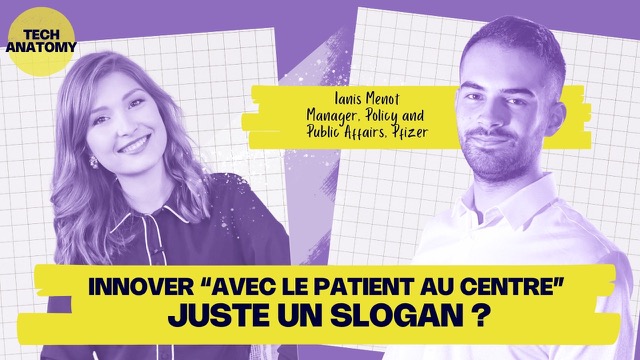
« Le patient au centre », au-delà du slogan - Ianis Ménot, Pfizer
Listen · 19 minSources
- Tech Anatomy, « Le patient au centre », au-delà du slogan, interview with Ianis Ménot, Manager Policy and Public Affairs, Pfizer France (in French), published 15 September 2026.
- Pour une e-santé qui profite à tous, manifesto of the Cercle P, Pfizer France, 2019
- Le Cercle P élabore un manifeste et dresse 5 propositions, press release, Pfizer France, 17 September 2019
- L'expérience patient : un levier de transformation ? 12 propositions issues du Forum Patient Pfizer, Pfizer France, June 2020
- Intégrer l'expérience patient pour un système de santé plus efficace : 6 propositions du Cercle P, press release, Pfizer France, 10 February 2021
- Décret n° 2024-468 du 24 mai 2024 relatif à la mise en œuvre de l'espace numérique de santé, Journal officiel, 26 May 2024
- Bientôt dans Mon espace santé : des conseils de prévention adaptés au profil des assurés, Ordre national des pharmaciens, 2024
- Un arrêté acte la participation des patients en formation initiale des médecins, Santé mentale, February 2025 (arrêté du 27 janvier 2025, JORF du 5 février 2025)
- Guide des cadres réglementaires à disposition des établissements d'enseignement supérieur pour le recours aux patients partenaires, French Ministry of Higher Education, 2025