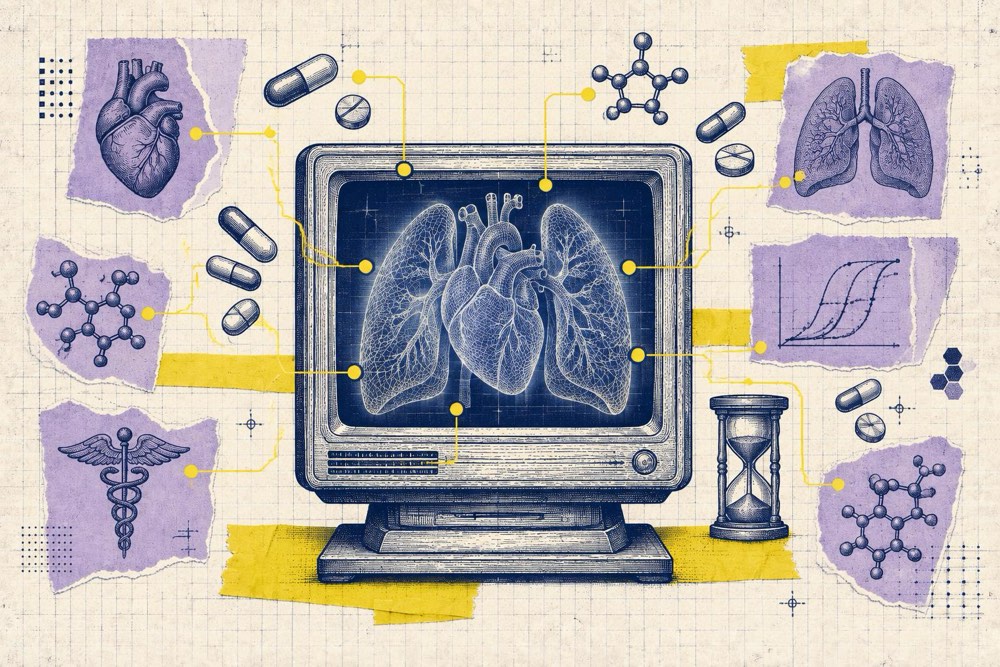
The scenario is easy to picture. A wearable records heart rate, sleep and activity, medical records add diagnoses and lab results, and all of it feeds an avatar that mirrors the body in real time. A hard training week makes it look fitter, a weekend of junk food makes it sluggish. The Tech Anatomy episode on digital twins, recorded in early 2025, explored that idea, along with a proposal popular in Web3 circles at the time: keep the health data in a personal digital wallet, controlled by the patient rather than by a platform.
The term "digital twin" has a more precise meaning than the avatar suggests. It comes from engineering, where manufacturers such as GE and Siemens built virtual replicas of jet engines, turbines and factories to test changes before applying them to the real thing. In a report released in December 2023, the US National Academies of Sciences, Engineering, and Medicine defined a digital twin as a virtual representation that is updated with data from its physical counterpart, can make predictions, and informs decisions. The committee insisted on one feature in particular: the information flows both ways. A model that is never updated with new data from the patient is a simulation, not a twin.
What exists in medicine today
Measured against that definition, the most advanced medical twins are partial: one organ, one disease, one decision.
The heart is the furthest along. Dassault Systèmes launched its Living Heart Project in 2014 to build a realistic computer model of the human heart, and signed a research agreement with the FDA the same year to explore how such models could be used to test cardiovascular devices. At Johns Hopkins, Natalia Trayanova's team built personalised heart models from each patient's MRI and used simulations to locate the tissue that should be destroyed to stop a dangerous rhythm disorder called ventricular tachycardia. Their 2018 study in Nature Biomedical Engineering combined retrospective data from 21 patients with a prospective feasibility test in five, and the authors described it as a proof of concept requiring larger trials.
The brain has a comparable project. In France, the EPINOV trial, coordinated from Marseille since 2019 across 11 hospitals, tests whether a patient-specific "virtual epileptic patient" model can improve surgery for epilepsy that resists drugs. More than 350 patients have been enrolled, and its main results were not yet published at the time of writing.
Other uses are further from a twin in the strict sense. Pharmacokinetic models and virtual patient cohorts used in drug development are often described with the same word; Tech Anatomy covered them in a separate article on virtual patients and drug modelling.
The data question the episode raised
The avatar scenario only works if very personal data flows continuously into a model. The episode's answer was Web3: a wallet that stores health records, with the patient granting or revoking access. The attraction is real. Under the platform model familiar from social media, the company that hosts the data sets the terms of its use, which feels inappropriate for information as revealing as a person's health.
The route that has gained ground in Europe since then is regulatory rather than technical. The European Health Data Space regulation, adopted in 2025, gives patients rights to access their electronic health data and control who can see it, and organises secondary use for research through national health data access bodies, with obligations phasing in from 2027. It addresses many of the same concerns through public infrastructure instead of individual wallets.
Two readings
One reading sees the organ-level twins as the first steps toward the full personal model. Each organ model, each validated use, adds a component, and wearables already supply the continuous data stream that a twin needs. On this view, the avatar is a matter of integration and time.
A second reading doubts that the pieces add up. A heart model used for one procedure is calibrated on high-quality imaging taken in hospital, not on consumer sensors, and its value comes from answering one precise question. A whole-body twin would need to model interactions between organs that are poorly understood, and would be very hard to validate, because there is no simple way to check that a model of a whole person is right. On this view, twins will stay specialised tools for specific decisions.
The episode also raised a psychological question without settling it: whether seeing a fluctuating image of oneself would motivate healthier choices or feed an unhealthy focus on performance and appearance. No study has measured that directly.
What the evidence does not show
The published clinical evidence for patient-specific twins consists mostly of feasibility studies and small cohorts. None has yet shown, in a completed randomised trial, that decisions guided by a twin improve outcomes compared with standard care. The phrase "digital twin" is also used loosely in marketing, sometimes for a dashboard of wearable data with no predictive model behind it, which makes claims hard to compare.
What to watch
The most informative near-term result will be the outcome of EPINOV, since it is a controlled trial of a patient-specific twin with a clinical endpoint, seizure freedom. Beyond that, the indicators are whether regulators accept twin-based evidence for devices or drugs, and whether the European Health Data Space makes it practical to feed such models with real patient data under clear rules. Each would also give a clearer sense of how far the personal avatar of the episode still is from clinical use.
Sources
- Tech Anatomy solo episode, Digital Twins: Are You Ready to Meet Your Healthier Avatar?, published March 2025.
- National Academies of Sciences, Engineering, and Medicine. Foundational Research Gaps and Future Directions for Digital Twins, National Academies Press, 2024 (released December 2023)
- Dassault Systèmes signs research agreement with the Food and Drug Administration for its Living Heart Project, Dassault Systèmes, 2014
- Prakosa A et al. Personalized virtual-heart technology for guiding the ablation of infarct-related ventricular tachycardia, Nature Biomedical Engineering, 2018;2:732-740
- EPINOV clinical trial: virtual brain technology to support surgery in drug-resistant epilepsy, EBRAINS, 2025
- Regulation (EU) 2025/327 on the European Health Data Space, Official Journal of the European Union