
The starting point was an advisory board on venous thromboembolism. At the end of the meeting, according to Guidado Tirera, the physicians around the table made a simple observation: the clinical guidelines they had just discussed were not easy to reach during a working day, and they changed often enough that nobody could keep the latest version in their head. European societies could afford to publish them in electronic form; at national level, he says, budgets and regulation made it harder.
Tirera is a pharmacist by training who spent seven years in the field as a medical science liaison, or MSL, the scientific counterpart of pharmaceutical companies who discusses data with physicians rather than selling products. He taught himself to code in order to build that guideline tool. He is a director at Pfizer, where his public profile gives his role as generative AI medical content lead in medical affairs, and, as he described it on air, works in a newly created team that produces AI-assisted content for medical affairs. In a three-part French-language Tech Anatomy series released in March 2026, he describes how that shift happened and what generative AI changes in the production of medical content.
He speaks as a Pfizer employee about his own work. What follows reports his account; the figures and practices he describes are internal and have not been published by the company.
From a guideline app to a dedicated team
In the first episode, From pharmacist to AI professional, Tirera describes the route. He started with Python, then switched to Swift, Apple's language for iOS apps, using Stanford's free online course. By 2019 he had a working app. His goal, which he now calls naive, was to show colleagues how easy such tools were to build. "The naivety in this story is that I really ignored all the regulatory constraints that exist, and they fundamentally change everything," he says (quotations translated from French).
The app then had to do more than display guidelines. Guidelines, he says, "are giant algorithms in text form", and he wanted to turn them into decision trees that a physician could step through. Converting text into those trees by hand was slow and error-prone, which led him to natural language processing, or NLP, software that extracts entities, relations and meaning from text. When ChatGPT appeared, he stopped developing the app, expecting large technology companies to solve the problem. He now thinks he misjudged it: the arrival of large language models, or LLMs, made his ideas feasible, and a whole ecosystem of products has since been built on them. The app remains on his phone.
Where the reported time savings sit
In the second episode, Tirera describes a team that pairs profiles. He works mostly with a medical writer who has around twenty years of experience and little background in AI, and with a developer who helps him build internal proofs of concept. The content they produce includes articles and slide presentations used by medical affairs colleagues in the field.
He gives two figures for slide and content creation. In experimental conditions, he says, the time needed fell by about 70 percent. In everyday use the gain is closer to 30 percent, which he attributes to how quickly teams absorb the tools. Both figures are his own and come from internal tests that have not been published. Pfizer has spoken publicly about generative AI for content on the marketing side: in February 2024, Digiday described Charlie, a platform built with Publicis that supports content creation and medical, legal and regulatory review, with an ambition to multiply content output rather than a measured saving.
The gain, in Tirera's account, sits at one step. "We are always in the logic of the first draft," he says. Quality control stays with a colleague, mainly because of sourcing: "In science, nothing matters more than sourcing the information you produce." Much of the development effort, he adds, goes into making the tool point to the exact passage of a source behind each statement, so that a reviewer can check it.
His working method follows the same logic. Early on he wrote long prompts that asked for many things at once, and the results disappointed him. He now breaks a task into steps, gives the model one piece at a time and assembles the output himself, so that he remains, in his words, "the orchestrator, the architect of what has to be done".
Asked about scientific papers that hide instructions for AI systems in their text, a practice Nikkei Asia documented in 17 arXiv preprints in July 2025, he calls it prompt injection and says he would rather check a synthesis himself.
Agents, and the line between internal and external use
The third episode turns to AI agents. Tirera contrasts a reactive LLM, which answers a question, with an agent that plans, uses tools such as web search, code or email, observes the result and loops until the task is done. For him the most useful agent today is the "deep research" function of general assistants, because it returns sourced reports. He lists possible uses inside a pharmaceutical company: drafting an article with several agents that write and critique each section before a human review, searching years of R&D documents, and scheduled scientific monitoring.
Patient-facing services are harder, he says, because of regulation. He cites the EU AI Act, which entered into force in August 2024 with obligations phased in. Bans on certain practices have applied since February 2025 and rules for general-purpose models since August 2025. In July 2026, a further regulation known as the Digital Omnibus on AI postponed the high-risk obligations, to August 2028 for AI built into regulated products such as medical devices. The second barrier he names is the black box: regulators struggle with systems whose internal reasoning cannot be fully explained. He offers a comparison with pharmacology: "The human body is so complex that we are a black box, quite simply. And yet we live with it," because treatments save lives. In the meantime, he sees partnerships with start-ups as the route companies use most.
He gives two reference points from outside Pfizer. At an Anthropic hackathon at Station F in Paris, his team built in one day an agent that transcribed a consultation, ran searches and suggested possible diagnoses; shortly afterwards, Microsoft launched Dragon Copilot, announced in March 2025, which drafts clinical notes from recorded consultations. He also cites Google's Med-PaLM medical language models and AlphaFold, the DeepMind protein structure system. Demis Hassabis, chief executive of Google DeepMind, shared half of the 2024 Nobel Prize in Chemistry with John Jumper for protein structure prediction. AlphaFold 3, published in 2024, extends prediction to complexes of proteins with DNA, RNA and small molecules.
Competing readings
One reading of the series is that generative AI in medical affairs is mainly a productivity tool for first drafts, bounded by the review that follows. On that view, the gap between 70 and 30 percent is a training and adoption problem, and the ceiling depends on how fast teams learn.
Another reading puts the constraint in verification. If every statement still needs an experienced person to trace it to its source, the saving at the drafting stage may move work to review rather than remove it, and the tools that matter most are those that make checking faster. Tirera's own account leans on both: he presents the review as essential and the sourcing feature as where development time goes.
What the series does not establish
The figures come from one person describing internal tests at one company, without a published method, baseline or measure of error rates in the drafts. The episodes do not say how review time changed, whether the quality of final content improved or declined, or how the approach compares across therapeutic areas. Most of the agent use cases describe possibilities rather than deployed systems.
What to watch
The indicators that would separate the two readings: whether companies publish time savings that include review and correction, not only drafting; whether citation-level traceability becomes a standard requirement for AI-generated medical content; and how the high-risk obligations of the AI Act are applied to patient-facing tools once they take effect. If review time falls along with drafting time, the productivity reading gains ground. If it does not, the question becomes how to make verification itself faster.
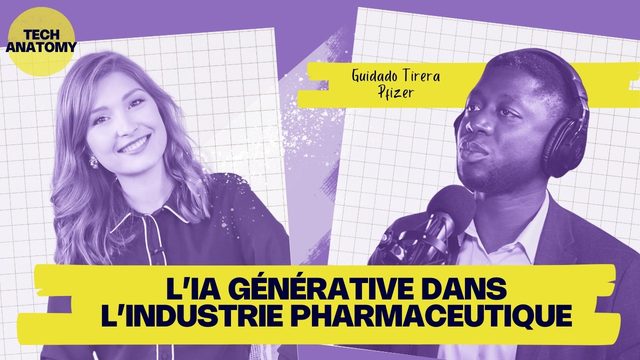
L’IA générative dans l’industrie pharmaceutique avec Guidado Tirera, Pfizer
Listen · 18 minSources
- Tech Anatomy, L'IA générative dans l'industrie pharmaceutique, with Guidado Tirera, Pfizer (in French), published 17 March 2026.
- Tech Anatomy, De pharmacien à pro de l'IA, with Guidado Tirera, Pfizer (in French), published 10 March 2026
- Tech Anatomy, IA agentique : la prochaine évolution ?, with Guidado Tirera, Pfizer (in French), published 24 March 2026
- With Charlie, Pfizer is building a new generative AI platform for pharma marketing, Digiday, February 2024
- 'Positive review only': Researchers hide AI prompts in papers, Nikkei Asia, July 2025
- Regulation (EU) 2024/1689 laying down harmonised rules on artificial intelligence (AI Act), Official Journal of the European Union, July 2024
- AI Digital Omnibus Regulation has been published, redefining deadlines, Garrigues, July 2026
- Microsoft put clinical productivity onstage at HIMSS25, Healthcare IT News, March 2025
- Singhal K et al. Large language models encode clinical knowledge, Nature, 2023
- The Nobel Prize in Chemistry 2024, press release, Royal Swedish Academy of Sciences, October 2024
- Abramson J et al. Accurate structure prediction of biomolecular interactions with AlphaFold 3, Nature, 2024