

On 16 September 2025, the Bordeaux company Synapse Medicine opened a free beta of MedGPT, a conversational assistant reserved for health professionals in France. Six months later, the company reported more than 65,000 professional users. By May 2026, according to the trade publication TICsanté, it claimed 154,000 verified users and integration into more than ten clinical software products, and in June the university hospital of Poitiers announced a deployment across its sites. Bordeaux and Brest are the other university hospitals the company cites as partners.
Dr Louis Létinier, medical director and co-founder of Synapse Medicine, described the reasoning behind the tool in an interview for Tech Anatomy published in January 2026. His premise is a familiar one: clinicians have less time, patients are older and take more medicines, and the volume of guidelines and publications keeps growing. A doctor with a patient in the room cannot search the literature. Synapse, founded in 2017 by two physicians and an AI engineer, already sold prescription support software, which Létinier described as class IIb medical devices; Mistral AI's own customer page states that more than 30% of French general practitioners and 300 hospitals use Synapse.
How the assistant is built
The architecture Létinier describes is what engineers call retrieval-augmented generation. Instead of letting a large language model answer from everything it absorbed during training, the system first searches a curated library and asks the model to answer only from the passages it retrieved. At Synapse, about fifteen physicians and pharmacists select that library, mainly official guidance: in France, the HAS (the national health authority), the medicines agency ANSM, the national health insurer, plus learned society recommendations and some publications. The documents are stored in a vector database, which represents each passage as a set of numbers so that the system can find the passages closest in meaning to a question.
Two consequences follow, by his account. Answers depend on the user's country, so a French doctor gets HAS guidance and a German doctor should not. And the system is designed to say when a question is unclear or when there is no consensus, rather than producing a fluent answer in every case, with further model layers checking the output. Each answer displays its sources and their dates, which Synapse's CEO Clément Goehrs called "the opposite of a black box" at launch.
Guidelines first, publications second
The main reference point in this market is OpenEvidence, a US assistant whose investors include Google's venture arm GV, which led a $200 million round in October 2025 at a reported $6 billion valuation. Létinier distinguishes the two by their sources. OpenEvidence, he says, starts from the scientific literature; MedGPT starts from guidelines. In his reading, that makes OpenEvidence better suited to research questions and MedGPT to daily practice. He also named a less obvious competitor: ChatGPT, which he says many clinicians, including in France, already use.
That is why the company compared MedGPT with ChatGPT rather than with a specialised tool. Before launch, it ran the 2023 edition of the ECN, the French national ranking examination for medical students, through both. Létinier said MedGPT answered about 80% of the multiple-choice questions completely correctly, counting any partly wrong answer as a failure; the launch material put it seven points above ChatGPT on 210 questions. He presented this as a safety check before release, not an evaluation, and said a study with several universities and independent experts was under way, with results expected within months. We did not find those results published as of November 2026. Exam scores measure recall and reasoning on written cases, a point this site has discussed with another researcher; they say little about effects on prescribing or outcomes.
How the company plans to pay for it
The tool is free after registration; at the time of the interview, unregistered visitors could ask two questions and registered professionals fifteen a day. Létinier did not rule out a paid tier for heavy users, but said the priority is business to business: software vendors that want to add generative AI to their products. A third source of value is the questions themselves. Synapse holds aggregated, anonymised data on what clinicians ask about treatments and diseases, which he called new and very rich. In March 2026 it published a first analysis: aid to diagnosis accounted for 55.4% of a sample of questions and drug prescribing for 47.5%, with general practitioners asking 52.6% of them, nurses 15.1% and pharmacists 13.7%. The terms of use ask professionals not to enter identifying patient data.
Létinier ruled out a patient version for now. Telling patients to use a powerful model to treat themselves would be dangerous, he said; a future patient tool would focus on spotting warning situations and directing people to care.
Two readings of the design
One reading sees the guidelines-first design as the right default for routine practice. Official guidance is what a clinician is expected to follow, it is adapted to national reimbursement and prescribing rules, and a narrower library reduces the room for confident errors. On this view, MedGPT channels into a supervised tool the use of general chatbots that hospitals cannot otherwise control, which is the argument Poitiers' IT director gave for choosing it.
A second reading focuses on what the design leaves open. Guidelines lag behind evidence, sometimes by years, and are thinner in rare diseases and surgical specialties, which Létinier acknowledged when he said performance drops as questions become more specialised. Sovereignty, central to the pitch, is also a matter of degree. Synapse works with Mistral AI and hosts data with a certified health data host in France, but according to APMnews, cited by Caducee.net, the tool was still running on Microsoft Azure in May 2026, and Létinier said a migration to a French provider was planned within the year. Finally, Létinier himself said that an AI that helps diagnose or recommend treatment "is necessarily a medical device" if one follows the logic through. MedGPT's terms of use describe it as providing information on recommendations and the proper use of health products, and we found no public statement that MedGPT itself carries a CE marking.
What the available data do not show
Almost every figure about MedGPT comes from the company: user numbers, the exam result, the usage barometer. The barometer describes what professionals ask, not whether the answers were right or changed a decision. The exam comparison was run once, by the developer, on questions that may resemble material available online. No published study yet compares outcomes for clinicians using MedGPT, a general chatbot or no assistant.
What to watch
The independent university evaluation announced in the interview is the first thing to look for, along with the method it uses: exam questions, real clinical queries scored by experts, or effects on prescriptions. The move off Microsoft Azure, the regulatory status of the assistant as it is built into prescribing software, and the planned country-by-country expansion in Europe will show whether the guidelines-first, sovereign approach scales. Each new country requires its own curated library, and how quickly a medical team can build one is a question the interview left open.
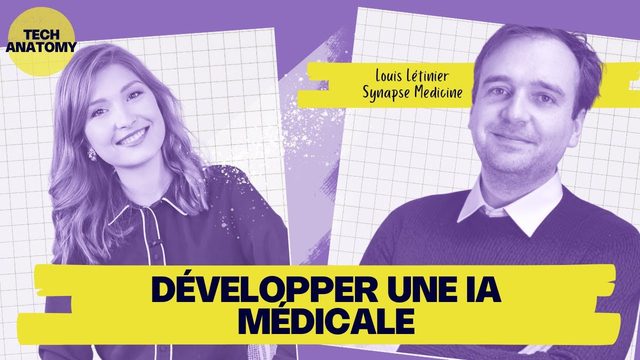
Développer une IA médicale : le cas MedGPT avec Louis Létinier, Synapse Medicine
Listen · 19 minSources
- Tech Anatomy, Développer une IA médicale : le cas MedGPT, interview with Dr Louis Létinier, Synapse Medicine (in French), published 13 January 2026.
- Synapse dévoile MedGPT : l'assistant IA médical 100 % français, Caducee.net, 17 September 2025
- MedGPT.fr : une IA conversationnelle au service de la décision médicale, interview with Louis Létinier and Thierry Houselstein, MACSF, 5 February 2026
- MedGPT : un baromètre qui éclaire les tensions du premier recours, Caducee.net, 17 March 2026
- MedGPT au CHU de Poitiers : l'IA médicale entre promesse clinique et surveillance, Caducee.net, 17 June 2026, citing APMnews and TICsanté
- Synapse Medicine, customer story, Mistral AI
- Conditions générales d'utilisation de MedGPT, Synapse Medicine, updated October 2026
- OpenEvidence, the ChatGPT for doctors, raises $200M at $6B valuation, TechCrunch, 20 October 2025
- Medical search engine startup OpenEvidence closes $200M investment led by GV, SiliconANGLE, 20 October 2025

