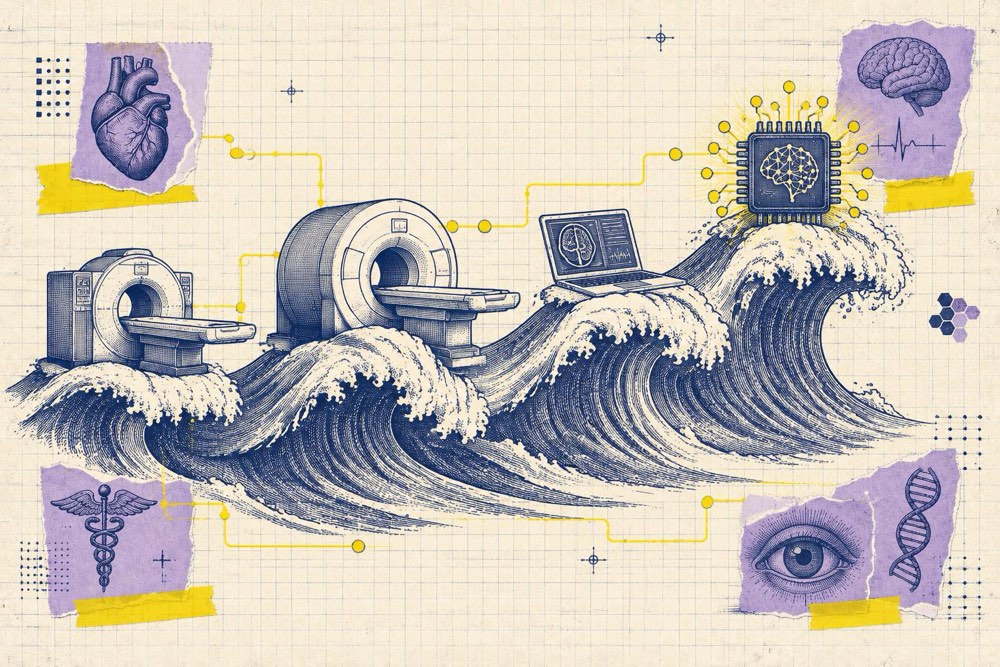
In the early 1990s, the Israeli company Elscint added a second row of detectors to a CT scanner, so that each rotation of the X-ray tube produced two slices instead of one. By 1998, the major manufacturers were selling four-slice systems. Sixteen-slice machines followed around 2001 and 64-slice machines around 2004. In November 2007, Toshiba obtained FDA clearance for the Aquilion ONE, whose 320 rows of detectors cover 16 centimetres of the body in a single rotation, enough to image the whole heart within one heartbeat.
Cristian Toader watched that race from inside the industry. After a doctorate in physics and about ten years in research and development, he moved to medical devices around 2004, working at GE, Medtronic and Boston Scientific, among others. In a French-language Tech Anatomy interview in September 2026, speaking in a personal capacity, he used the CT race as the first example of a pattern that has followed him through his career. Quotations are translated from French.
He recalls going "from 2 to 320" in under five years; the published record puts it closer to fifteen years from the first dual-slice scanner, and about a decade from the first four-slice systems.
A race on a physical limit, then a correction
Adding detector rows was, in his words, a way of "pushing back the physical limits": covering a larger part of the body in each rotation, at finer spatial resolution. "Like any breakthrough race," he says, "it has a cost somewhere. And the cost, in this case, was the dose."
In 2007, a review in the New England Journal of Medicine by David Brenner and Eric Hall estimated that a small share of future US cancers could be attributable to CT scans then being performed. Radiology bodies disputed its assumptions, but in 2010 the FDA launched an initiative to reduce unnecessary radiation exposure from medical imaging. Toader describes the industry turning towards seeing "more with less dose", including detectors that count individual photons; the FDA cleared the first photon-counting CT scanner in September 2021. His own reading of the slice race is that "with 64 slices, it already did almost everything."
He sees the same arc in MRI, where magnet strength rose to 1.5 and then 3 tesla before research systems went higher. In his view, 1.5 and 3 tesla proved "largely enough" clinically, and the cost there was economic rather than a risk to patients. The frontier still moves in both directions: the FDA cleared a 7 tesla scanner for head and limb imaging in 2017, and a portable low-field MRI that can be wheeled to the bedside in 2020.
The pattern he draws: the industry takes a technology from fundamental research, races to apply it, meets a cost, and corrects. The waves, he says, "do not disappear completely," they transform.
Genomics, data infrastructure and AI: different locks
The next wave he describes broke a cost barrier rather than a physical one. The Human Genome Project, completed in 2003, was followed by a collapse in sequencing costs, from close to 100 million dollars per genome in 2001 to a few hundred dollars by 2022, according to the National Human Genome Research Institute. Toader recalls a time when it was enough to mention preclinical imaging in a grant application to obtain funding, a trend that "went up and came down very quickly." Adoption in the clinic was slower, in his account, "because there were not always treatments on the other side", beyond some applications in oncology.
His third category is quieter: picture archiving and communication systems (PACS), which store and retrieve medical images digitally, and total lab automation, which links the instruments of a diagnostic laboratory into a single automated line. "That is not a wave," he says. "It is more of a rise, and it stayed." These systems still do not fully talk to each other, although, he argues, "interoperability is never a technological problem."
The fourth wave is artificial intelligence, which he frames as a new way of searching through the information that the previous wave stored. For him, adoption depends on alignment between three things: reimbursement, a demonstrated benefit for patients, and an understanding of how the technology works. Total lab automation spread because a shortage of qualified staff, an available solution and an economic gain pointed the same way. Administrative AI spreads quickly because it handles tasks nobody is attached to. In clinical use, he notes, the large medical device companies move at several speeds, and "the big ones are big because they have been managing risks for a hundred years already." His personal view is that much of the AI already in clinical practice is machine learning of the older kind, while generative AI sits mostly in administration, research and engineering. The history of AI in imaging is told in a separate Tech Anatomy article.
Two ways to read the pattern
One reading takes Toader's model as a description of how medical technology matures: what remains after the correction becomes infrastructure. In his words, "there is no Google Health at the moment, there is no Watson", yet the big data infrastructure built in that period still supports PACS and today's AI tools. Google dismantled its Google Health division in 2021, and IBM sold its Watson Health data assets in 2022, which became Merative. On this view, the AI wave will correct too, and the question is what it will leave.
A second reading puts more weight on what pushes the corrections. The dose correction in CT came alongside public research and regulatory pressure, not only from manufacturers deciding the race had gone far enough. The genomics slowdown reflected the pace of drug development, which device makers do not control. On this view, the pattern is real but driven by actors outside the industry, which fits Toader's own idea of alignment while shifting attention to the institutions that decide when a cost becomes unacceptable.
What a single career cannot show
The episode is one person's account of two decades, given from memory, with approximate dates. A career at large manufacturers sees the waves from the supplier side; a radiologist or a payer might date the same corrections differently. His remarks on how companies adopt AI are impressions of the firms he knows, not a survey. His split between machine learning in the clinic and generative AI in the back office describes authorised medical devices; it says nothing about how clinicians use general-purpose chatbots on their own.
What would test the model
If the pattern holds, AI in medicine should show the same sequence: a race on a single performance metric, a cost that becomes visible, and a correction. The indicators to watch are where that cost appears first, whether in errors, liability, the price of running large models or the time clinicians spend checking outputs; whether reimbursement, patient benefit and understanding of the technology begin to align for any clinical AI use beyond imaging triage; and which parts of the current infrastructure are still in use once the term "AI" itself stops carrying a premium. Toader, who calls himself an apprentice because the field keeps moving, also asked for one word to be dropped from the discussion: "revolution", which in scientific terms, he notes, means leaving a point and arriving back at the same one.
Sources
- Tech Anatomy, Du scanner à l'IA : l'évolution médicale, interview with Cristian Toader (in French), published 9 September 2026.
- Elscint's twofer CT breaks ground, Diagnostic Imaging, February 1992
- Flohr TG et al. Multi-detector row CT systems and image-reconstruction techniques, Radiology, 2005;235:756-773
- Toshiba receives FDA clearance for Aquilion ONE, Toshiba America Medical Systems (now Canon Medical), November 2007
- Brenner DJ, Hall EJ. Computed tomography, an increasing source of radiation exposure, New England Journal of Medicine, 2007;357:2277-2284
- Initiative to reduce unnecessary radiation exposure from medical imaging, US Food and Drug Administration, 2010
- FDA clears Siemens photon-counting CT scanner, AuntMinnie, September 2021
- FDA clears first 7T magnetic resonance imaging device, US Food and Drug Administration, October 2017
- World's first bedside MRI system receives FDA 510(k) clearance, Hyperfine, February 2020
- The Human Genome Project, National Human Genome Research Institute
- DNA sequencing costs: data, National Human Genome Research Institute
- bioMérieux announces US FDA clearance of VITEK MS, bioMérieux, August 2013
- Google Health dismantled as David Feinberg departs, STAT, August 2021
- Merative, a new data company, formed from IBM's healthcare analytics assets, Healthcare IT News, 2022