
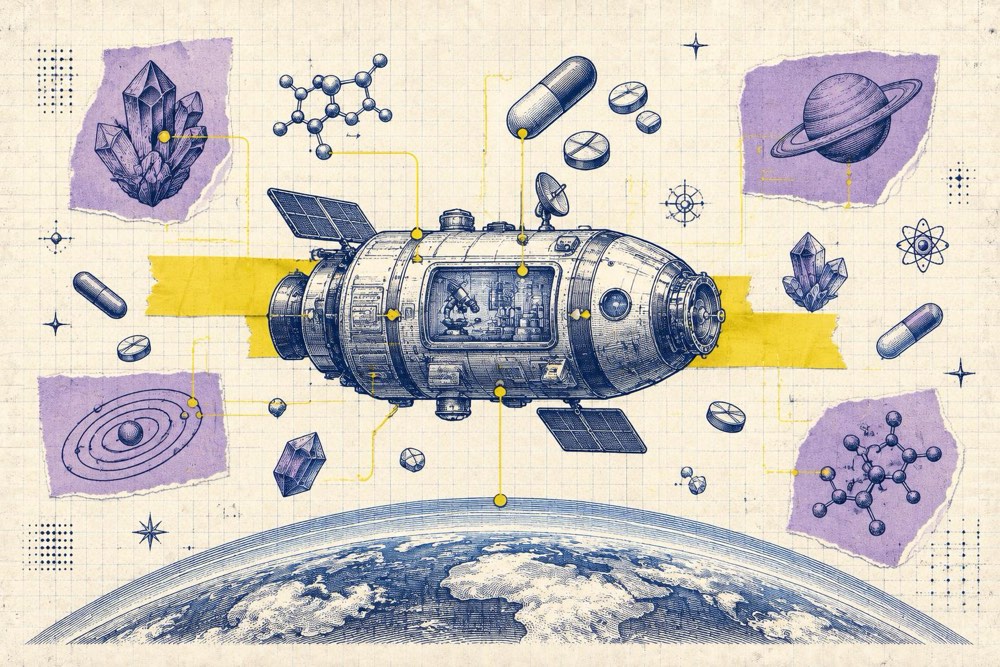
In February 2017, a SpaceX resupply mission carried a set of crystallisation experiments from Merck to the International Space Station. The molecule was pembrolizumab, the antibody sold as Keytruda, a checkpoint inhibitor that helps the immune system recognise tumour cells. In 2019, Merck researchers reported in npj Microgravity that the space-grown samples formed crystalline suspensions with a single, uniform particle size of about 39 micrometres, while ground controls produced a mix of particles around 13 and 102 micrometres. The space samples were also less viscous, which matters for anything meant to pass through a syringe needle.
James Kingsnorth, a planetary scientist by background, is payload scientist at Tumbleweed, an Austrian start-up founded in 2024 and based in Vienna and Delft that builds small laboratories for orbit; earlier company announcements, from its Mars rover project, presented him as head of science. He calls this case "almost like the North Star" for research in microgravity. In an interview for Tech Anatomy in May 2026, he described what the absence of gravity changes for biology, and why he thinks the bottleneck has been access to orbit more than the science itself.
What changes when gravity is removed
Kingsnorth describes gravity as "almost like a noise filter in many ways". On Earth, it drives convection, the churning of fluids as warmer and lighter parts rise, and sedimentation, the settling of heavier particles to the bottom. Both disturb a slow, delicate process such as crystal growth. Without them, he says, proteins form "much more uniform and more crystalline, more like denser crystals for proteins with fewer defects".
The second application he points to is three-dimensional tissue. Cells grown in a Petri dish tend to spread into flat layers. In orbit, without sedimentation, they can assemble into organoids, small structures that reproduce part of an organ's architecture, which he argues are closer to the human body than a flat culture.
The third is time. Some physiological changes are faster in space. NASA reports that astronauts can lose 1 to 2 percent of bone mass per month in the hip and spine, against 0.5 to 1 percent per year for older adults on Earth. Kingsnorth describes the environment as "almost like a time machine" for studying ageing, and mentions an early-stage collaboration with a Dutch medical university comparing treated and untreated immune cells under these conditions.
What the Keytruda case does and does not show
The 2019 paper describes how the team then used rotational mixers on the ground to limit sedimentation and reproduce part of the effect, obtaining suspensions with acceptable viscosity for injection. The orbital experiment served as a reference, and the process was rebuilt on Earth.
In September 2025, the FDA approved Keytruda Qlex, a subcutaneous version of pembrolizumab that can be injected in one to two minutes, compared with a 30-minute intravenous infusion. In the interview, the link between the space work and this product is drawn directly. The public record is less direct. The approved product pairs pembrolizumab with berahyaluronidase alfa, an enzyme that helps a larger volume disperse under the skin, and the published sources describe the space experiments as work that "could help" subcutaneous delivery, without quantifying their contribution to the final formulation.
The commercial figure also needs context. Keytruda brought in about $31.7 billion in 2025, according to Merck. The subcutaneous version accounted for $40 million of that, in its first months on the market. Nearly all the revenue still comes from the intravenous drug, which predates the space experiments.
How access to orbit has changed
Kingsnorth's case for the field rests on access. Launch prices have fallen sharply: a 2018 NASA analysis put the Space Shuttle at about $54,500 per kilogram to low Earth orbit and the Falcon 9 at about $2,700 per kilogram for a full rocket. Small payloads sharing a SpaceX rideshare flight paid around $7,000 per kilogram in 2026, according to industry price trackers. He also points to new European launchers, including the French start-ups Latitude and HyPrSpace, the latter of which signed a partnership with Tumbleweed in June 2026.
The other barrier is administrative. Experiments bound for the ISS go through long safety reviews, and Kingsnorth says he has heard of cases taking up to ten years. Tumbleweed's answer is the Pod, a pressurised, pre-certified container ranging from 10 by 10 by 2.5 centimetres to roughly microwave size. Because the Pod isolates faults, whatever happens inside cannot affect the rest of the spacecraft, so the customer's own hardware does not need full space qualification. "Inside of this box is Earth conditions, but without gravity," he says. For one customer, he says, the paperwork came down to "a bill of materials, one spreadsheet, and that's it".
Tumbleweed's first mission, Oasis Alpha, launched on SpaceX's Transporter-17 flight on 7 July 2026 with experiments from four customers, all new to space. It could send data back but not samples. A second mission with a return capsule, Oasis Beta, is planned for 2028. The company, which operates between Vienna and Delft, announced a €6.9 million seed round in November 2026.
Two readings of where space pharma stands
One reading is that the conditions for a new research tool are now in place: cheaper launches, standardised containers, automated hardware, and a need for new capacity as the ISS approaches its planned retirement around 2030. Varda Space Industries, which crystallised the antiviral ritonavir in orbit and returned it to Utah in 2024 before landing a second capsule in South Australia in 2025, is often cited as evidence that return missions can be repeated.
The other reading is that the biology still has to prove its value to the people paying. Kingsnorth acknowledges this himself. Many in pharma are "on the fence", he says, because "the actual ramifications and sort of return on investment is not so clear". He places drug manufacturing in orbit "maybe 10 years away", and says Tumbleweed is currently "operating at a loss" while it flies early prototypes. In his view, space would become "almost like another step in the manufacturing process", but how that step would fit into a commercial supply chain has not yet been demonstrated.
What the interview does not establish
The interview reflects the view of a scientist at a company that sells access to microgravity. Several figures given on air were approximate: Kingsnorth spoke of a 60-minute infusion reduced to 60 seconds and of about $25 billion in annual sales, where the published figures are 30 minutes, one to two minutes, and $31.7 billion. His estimate that about 95 percent of microgravity experiments take place on the ISS could not be checked against a public source. The pembrolizumab study itself concerns one molecule and one set of crystallisation conditions, and it does not show that every protein behaves better in orbit.
What to watch
The questions that would settle the debate are concrete. Will Oasis Beta, or another return capsule, bring samples back on a schedule regular enough for a drug development programme to depend on it? Will a pharmaceutical company publish a second case comparable to pembrolizumab, with ground controls and a clear account of what the orbital data changed? And as the ISS winds down, will commercial stations and free-flying platforms absorb its backlog of experiments, or will capacity shrink before the new model is proven?
Beyond Earth: Space-Based Drug Discovery - James Kingsnorth, Tumbleweed
Listen · 28 minSources
- Interview with James Kingsnorth, Tumbleweed. Recorded for Tech Anatomy, published 19 May 2026.
- Reichert P et al. Pembrolizumab microgravity crystallization experimentation, npj Microgravity, 2019;5:28
- Published results from crystallization experiments on the ISS could help Merck improve cancer drug delivery, ISS National Laboratory
- FDA approves Merck's Keytruda Qlex for subcutaneous use, Merck, September 2025
- Merck announces fourth-quarter and full-year 2025 financial results, Merck, February 2026
- Jones HW. The recent large reduction in space launch cost, NASA Technical Reports Server, 2018
- Satellite ridesharing market analysis 2026, New Space Economy, February 2026
- Bone and mineral evaluation and analysis, NASA
- Tumbleweed raises record €6.9M seed round to bring microgravity research to the masses, Tech.eu, November 2026
- Tumbleweed Pod, ESA Business in Space Growth Network
- Varda's second capsule successfully lands in Australia, Via Satellite, February 2025
- HyPrSpace dévoile un partenariat avec la start-up autrichienne Tumbleweed (in French), Le Journal des Entreprises, June 2026
- NASA selects SpaceX to bring ISS out of orbit in 2030, Astronomy, June 2024