

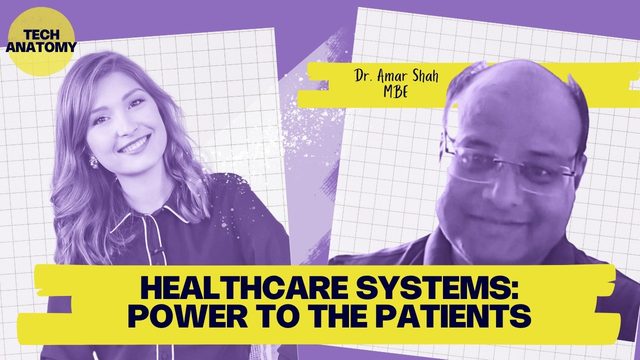
When Amar Shah joined East London NHS Foundation Trust (ELFT) in 2011, its reporting was built around one question: are we meeting our targets? "It's a very simple question, but it only has two answers," he said in an interview for Tech Anatomy. A yes or no sends attention to the services that are failing and tells nobody much about the ones doing well.
Shah is a consultant forensic psychiatrist. He spent fifteen years at ELFT, which provides mental health, community and primary care services to about 1.8 million people in east London, Bedfordshire and Luton, and sat on its board for almost nine of them as chief quality officer, a post the trust describes as the first of its kind in England. He stepped back from that role in early 2026. In January 2024 he was also appointed, on a part-time secondment, NHS England's first National Clinical Director for Improvement, and he was made an MBE in the King's Birthday Honours in June 2024. The interview was recorded shortly after he spoke at HIMSS26 Europe in Copenhagen in May 2026.
His central claim is that "it's the system that produces the experience and the outcomes", not the effort or failings of individual staff.
From assurance to improvement
Quality assurance checks whether standards are met. Quality improvement, as Shah uses the term, is a structured method for solving a problem with the people closest to it: set an aim, decide how change will be measured, test ideas in small cycles. ELFT has used the Model for Improvement, a widely taught version of this method, since 2012. The shift he describes is from a "deficit oriented approach" to one that studies the whole range of variation, learning from the teams that do well as much as from those that struggle.
ELFT was rated Outstanding by the Care Quality Commission, the regulator for health and social care in England, for the third time in January 2022, the first community and mental health trust to receive that rating three times.
Patients inside the organisation
Shah says the trust already had a strong patient voice in 2011. Fifteen years later, by his account, "every single job interview has a patient on the panel", including the chief executive's, training is delivered jointly by staff and patients, and patients take part in business cases, tenders, research and improvement work. He adds that mental health services have a longer history of shared decision making than other sectors.
What generative AI did in a quality improvement team
ELFT's quality improvement department tested generative AI tools on its own work between December 2023 and September 2024, mainly Microsoft Copilot, which fitted the trust's information governance rules. The results, published in the British Journal of Healthcare Management in 2025, cover 49 tests run by the department's 16 staff. Users rated 85% of tasks helpful.
Shah singles out two uses. The first is building a theory of change: asking whether anyone has already solved a similar problem, a task that once meant a library search. The second is measurement, which many teams find hard; given a problem and an aim, a chatbot produces "a very good first draft" of a measurement plan. Visual tools were weaker at the time. The paper reports that driver diagrams and fishbone diagrams often did not match what staff had in mind, and that Copilot could not read the axis of a large Pareto chart. Shah thinks newer tools now do much better with run charts and driver diagrams. The 2024 study did not test those newer tools.
Equity and the limits of a tool
On fairness, Shah treats generative AI as "just another type of change", to be checked for whether it widens existing gaps in access or outcomes. Models, he says, are "only as accurate as the data on which they've been tested". He gives UK Biobank, one of the largest health research cohorts, as an example of a dataset that does not reflect the population. The published figures put the share of participants of white ethnicity at about 94.6%, leaving roughly 5% from other groups, rather than the 1% mentioned on air, and still well short of the diversity of east London, where he says around a hundred languages are spoken.
On AI scribes, which record a consultation and draft the clinical note, the interview referred to a JAMA Network Open study published in October 2025. Among 263 clinicians in six US health systems, the share reporting burnout fell from 51.9% to 38.8% after 30 days of use. It was a before-and-after survey, not a randomised trial. Shah welcomes any reduction in burden, notes that scribes "haven't been shown to improve productivity yet", and argues that "the absence of burnout does not equate to joy".
Data organised around teams
As executive lead for data and analytics, Shah set out to map every dataset back to the clinical team, so that a team could see its clinical, safety, finance and workforce data in one place. Most organisations cannot, he says, because their systems were set up separately. The trust built some thirty analytics apps on shared design principles: start from the team, show variation over time rather than pass or fail, and make data open to everyone, since "data can be a very big reinforcer of power hierarchy in organizations". His conclusion is that "this is not a technology issue" and that a clinician should own data at executive level.
Two ways to read the East London story
One reading is that the method travels: the patient involvement, the data design and the habit of testing before scaling explain the results, and other trusts can adopt them. Shah's own warnings support a second reading. He calls "rolling out" one of his "bugbears" and cautions against assuming "a recipe that works for one place will just work everywhere". ELFT also kept the same commitment through four chief executives, and, he says, recruited to the chief executive role on the strength of it. Continuity of that kind is harder to transfer than a technique, and the East London record alone cannot show which of the two did more of the work.
What the interview does not establish
The conversation reflects the view of the person who led the approach. Patient involvement and the analytics apps are described by Shah, not measured independently. The generative AI study relied on users rating their own experience, with no measurement of time saved, as the authors acknowledge. The scribe study measured self-reported burnout at 30 days, not long-term effects or patient outcomes.
What to watch
Shah now works on improvement for the whole NHS in England, where his own advice is to test, adapt and learn rather than roll out. The useful signals will be whether trusts with different starting points build their own versions of the approach, whether analytics designed around teams spreads beyond a handful of organisations, and whether studies of AI scribes and generative AI begin to report outcomes beyond user satisfaction. How a national body promotes a method while letting each organisation find its own path is a question the interview leaves open.
Sources
- Tech Anatomy, Healthcare Systems: Power to the Patients, with Dr Amar Shah MBE, published 9 June 2026.
- Chief Quality Officer Dr Amar Shah becomes first National Clinical Director for Improvement, East London NHS Foundation Trust, January 2024
- MBE for doctor improving the quality of health care, East London NHS Foundation Trust, June 2024
- Trust seeks successor to long-serving Chief Quality Officer, East London NHS Foundation Trust, 2025
- CQC rates East London NHS Foundation Trust Outstanding for the third time, Care Quality Commission, January 2022
- Sorlie C et al. Leveraging artificial intelligence to support the application of quality improvement in healthcare, British Journal of Healthcare Management, 2025
- Olson KD et al. Use of Ambient AI Scribes to Reduce Administrative Burden and Professional Burnout, JAMA Network Open, October 2025
- Fry A et al. Comparison of Sociodemographic and Health-Related Characteristics of UK Biobank Participants With Those of the General Population, American Journal of Epidemiology, 2017
- HIMSS26 Europe welcomes world-class voices to Copenhagen, HIMSS, April 2026