
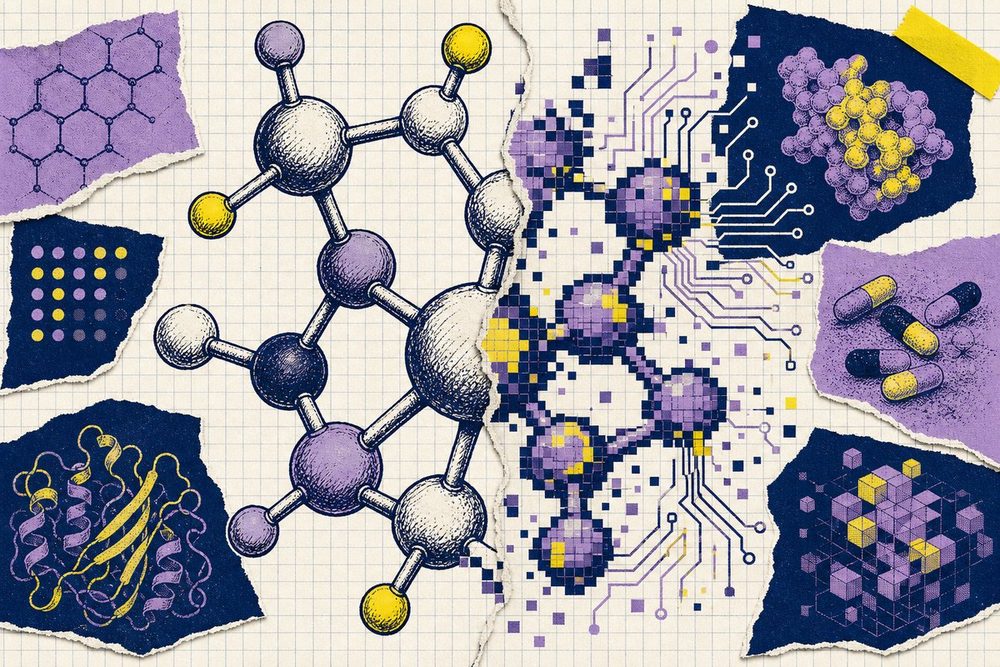
Every conventional computer, from a phone to a hospital server, processes information as bits: switches that are either on or off, one or zero. A quantum computer uses qubits, which follow the rules of quantum mechanics and behave differently. Before it is measured, a qubit can be in a combination of zero and one at the same time, a property called superposition. Measuring it forces it into one of the two values.
A useful picture is a coin. A bit is a coin lying flat, heads or tails. A qubit is closer to a coin still spinning on its edge, which only settles on one face when it stops. Qubits can also be entangled, meaning their states are linked so that measuring one tells you something about the other, however far apart they are. Entanglement does not let anyone send a message faster than light, a point often lost in popular accounts, but it does let a quantum computer represent correlations between many variables that would be very costly to track on ordinary hardware.
These two properties are what make quantum computing interesting for a narrow class of problems. They are also why the field is easy to oversell.
Why molecules are the natural target
The idea that quantum machines suit chemistry goes back to the physicist Richard Feynman, who argued in a 1981 lecture, published in 1982, that nature is quantum mechanical and that simulating it faithfully would require a computer that is quantum mechanical too.
Drug design is a case in point. Whether a candidate molecule binds to a protein, and how strongly, depends on how electrons are shared between atoms. Conventional computers handle this with approximations, which work well for many molecules and poorly for some, notably those involving metals or electrons that strongly influence one another. The cost of an exact calculation grows so fast with the size of the molecule that exactness is out of reach beyond very small systems. A quantum computer, in principle, can represent those electronic states more directly, because it obeys the same physics.
How large a machine that requires is a matter of published estimates. A 2017 study in PNAS examined an enzyme involved in nitrogen fixation, a classic hard case for chemists, and concluded that a useful simulation was feasible on a quantum computer, but on one with error correction: a machine able to detect and fix its own errors continuously, far beyond what existed then.
Where the hardware stands
Quantum hardware is fragile. Most current machines run at temperatures close to absolute zero, and qubits lose their state through tiny disturbances, which introduces errors. The central engineering problem is error correction: combining many physical qubits into one more reliable "logical" qubit.
In December 2024, Google announced Willow, a 105-qubit chip, and reported in Nature that adding more physical qubits to a logical qubit reduced its error rate rather than increasing it. Crossing that threshold had been a long-standing goal. Commentators noted that the demonstration concerned storing quantum information reliably, not yet running long error-corrected calculations.
Access is no longer limited to the laboratories that build these machines. IBM, Amazon Web Services and Microsoft offer cloud access to real quantum processors, so a research group can run small experiments without owning one. Google's processors are available to selected research partners. Some hospitals have gone further. In March 2023, Cleveland Clinic and IBM unveiled an IBM Quantum System One on the clinic's campus, presented by both partners as the first quantum computer dedicated to healthcare research, within a ten-year partnership that includes drug discovery projects.
What quantum computers are not for
Quantum computers are not faster versions of laptops. For email, imaging software or electronic health records, conventional machines remain better and will stay so. The expected gains are confined to problems with a particular mathematical structure: simulating molecules and materials, some optimisation problems, and factoring very large numbers. The last one is why security specialists pay attention. A large enough quantum computer could break some of the encryption that protects data today, including health data, which is why the US National Institute of Standards and Technology published its first "post-quantum" encryption standards in August 2024, well before such a machine exists.
Two readings of the same progress
One reading holds that the field has entered an engineering phase. Error correction has been shown to work in principle, roadmaps from the main companies point to larger error-corrected machines within this decade, and the pharmaceutical groups and hospitals that invest now will be the ones able to use them when they arrive. On this view, waiting for proof means arriving late.
A second reading is more cautious. A 2024 survey of quantum methods for drug discovery notes that large, fault-tolerant machines are still under development and that it remains unclear which drug discovery problems are best suited to them. Classical methods, including AI models for molecular structure, keep improving at the same time, which moves the bar a quantum machine has to clear. On this view, current medical projects are mostly about building skills, and their scientific output should be judged accordingly.
Both readings accept the physics. They differ on timing, and on how much of today's spending is preparation rather than results.
What the episode and the evidence do not settle
The Tech Anatomy episode imagined quantum computers simulating every interaction between a drug and the cells of a body, and powering detailed digital twins of patients. Those are long-range possibilities, not current capabilities. No published study has yet shown a quantum computer solving a medically relevant chemistry problem that a conventional computer could not. Resource estimates for useful simulations also depend heavily on assumptions about error rates and algorithms, and they have shifted by large factors from one paper to the next.
What to watch
Three indicators would mark a real change. The first is a peer-reviewed chemistry calculation, on a molecule that matters to medicine, where a quantum machine does better than the best classical methods and the comparison is checked independently. The second is the number of logical qubits that can run deep calculations, rather than the raw count of physical qubits that headlines tend to report. The third is whether the hospital and pharmaceutical partnerships announced since 2023 publish results that go beyond feasibility. How soon any of the three happens is where informed observers still disagree most.

Sources
- Tech Anatomy solo episode, Medical Quantum Computing Massively Simplified, published April 2025.
- Feynman RP. Simulating physics with computers. International Journal of Theoretical Physics, 1982;21:467-488
- Google Quantum AI. Quantum error correction below the surface code threshold, Nature, 2025;638:920-926
- Meet Willow, our state-of-the-art quantum chip, Google, 9 December 2024
- Cleveland Clinic and IBM unveil first quantum computer dedicated to healthcare research, Cleveland Clinic, 20 March 2023
- Reiher M et al. Elucidating reaction mechanisms on quantum computers, PNAS, 2017;114:7555-7560
- Quantum-machine-assisted drug discovery: survey and perspective, arXiv, 2024
- NIST releases first 3 finalized post-quantum encryption standards, NIST, 13 August 2024
- Azure Quantum, Microsoft
- Amazon Braket, Amazon Web Services
- IBM Quantum Platform, IBM