
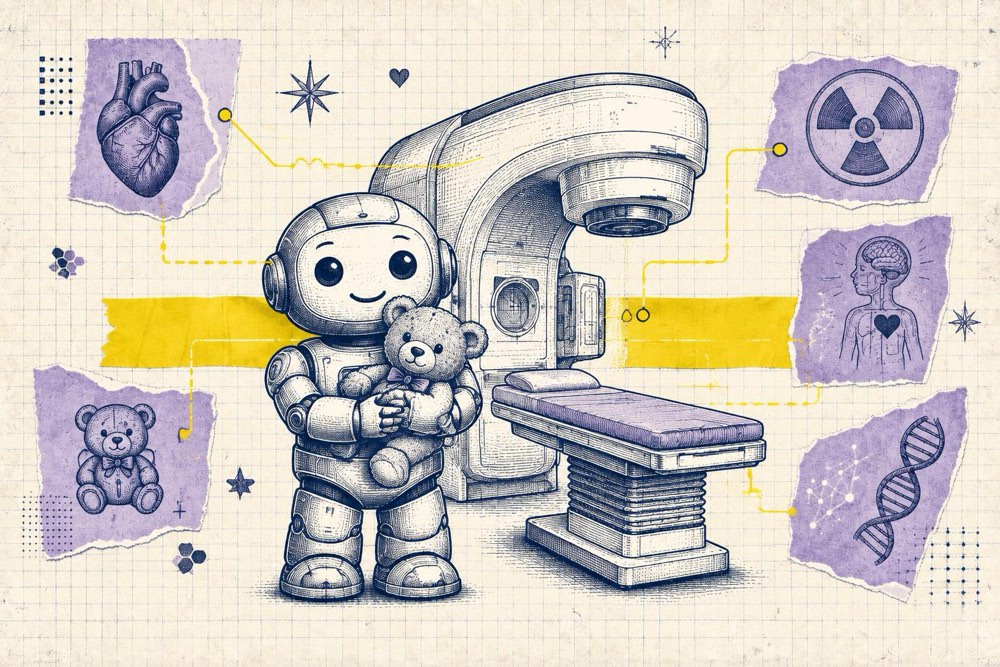
Radiotherapy for a child usually means a session every weekday for one to two months. Each time, the child has to lie completely still in a shielded treatment room, often called the bunker, while a linear accelerator delivers the dose. The walls that stop the beam also keep everyone else out. Parents can stay at the bedside during chemotherapy and walk their child to the operating theatre, but for radiotherapy, the child goes in alone.
Dr Julien Welmant, a radiation oncologist who treats children at the Institut du Cancer de Montpellier (ICM), described this moment in an interview for Tech Anatomy in September 2026. The team already had tools: virtual reality headsets, a cuddly toy, music, parents speaking through the intercom. In his words (translated from French), "there is no presence. You are still alone." Since October 2025, according to the robot's manufacturer, a humanoid robot called Miroki has been allowed into the treatment room with children at the ICM, when the care team and the treatment protocol permit it. The ICM describes the project as a world first.
How the project was assembled
Welmant traces the idea to a five-year-old patient who cried through every session for two months, and to a robot in a Japanese shop that handed him a towel on a rainy evening. A university robotics department quoted him, by his account, five years and five million euros to build one. He eventually found Miroki, developed by the French start-up Enchanted Tools for logistics in public settings, and called the company. Funding for the first robot came from local donors, about 160,000 euros by his account, a fundraising effort the ICM attributes to Sandrine Moustardier with the support of the association La Bonne Etoile. In June 2025, the Altrad group's endowment fund announced 600,000 euros over three years to take the project from pilot to clinical evaluation.
He is precise about the division of labour. Enchanted Tools builds the hardware: motors, autonomy, movement, and the facial animation and small sounds the robot uses for non-verbal communication. The conversational layer currently runs on Google's Gemini, chosen, he says, for its languages and response speed. Response time remains the weak point: about 1.3 seconds today, down from around four at the start, still enough to break a conversation's rhythm. The Montpellier team is considering a smaller model, or one dedicated to radiotherapy. What the hospital added was a set of constraints on what the model may say. If a child asks whether they are going to die, the robot is instructed to answer that this is a question for their doctor. "We did not create the robot," he says. "We created the whole ecosystem and the care pathway around it." That includes a department redesigned as a spaceship cockpit.
What the first patients showed, and what they cannot show
The case Welmant returns to is a young girl who began her treatment before the robot had clearance to enter the room. She arrived silent and withdrawn on her stretcher. Once the robot accompanied her, he says, she walked in on her own, and the next day she ran to her session. A year or so later, asked what radiotherapy was like, she said it was great. "The treatment has not changed," he notes, "but the memory she has of it is radically different."
His argument for why this matters is long-term. Children who go through heavy treatment can develop post-traumatic stress, and some later avoid doctors altogether, which can delay the detection of late effects or relapse. If the memory of treatment is less frightening, the reasoning goes, fewer of these patients will be lost to follow-up years later. He qualifies it himself: "we are not sure if it is at ten years, so it is hard to predict."
Simulated empathy, and who it suits
Welmant is working on an avatar of himself that sends each patient a personalised video before a first consultation, asking them to bring their documents and prepare their questions. Asked whether an avatar should announce test results instead of the doctor, he answers that it is a bad idea.
On empathy, his description is practical. He calls what a robot offers as "simulated empathy": slowing down, listening actively, not looking away, not cutting the other person off. He also concedes that the same techniques could be put to malicious use by exploiting human biases. And he observes that the effect depends on the audience. It relies on what he calls the suspension of disbelief, the capacity to know something is fiction and engage with it anyway. In his experience, children and older people do this easily, while adults in their forties and fifties find it much harder.
Two readings of the same project
One reading treats Miroki as a narrow, practical fix for a specific gap: a room no adult can enter, at an age when being alone is frightening. In that view, the robot does not replace anyone, because no human could be there in the first place, and its value can be judged by the same standard as any supportive care intervention.
A second reading, which Welmant says he met inside the hospital, starts from opportunity cost. When he presented the project, he was told the money could pay for nurses or for safer innovations. Seen this way, the question is not whether the robot comforts children, but whether it comforts them more than the same resources spent on people would. Both readings take children's anxiety seriously; they differ on the comparator.
What the episode does not establish
The evidence presented in the interview is anecdotal: individual children, observed by the clinician who started the project. The scientific evaluation coordinated by the SIRIC Montpellier Cancer is meant to measure two things, how clinicians adopt the robot and its effect on children's anxiety, and no results had been published at the time of writing. A first study, KOKORO01, was registered on ClinicalTrials.gov in June 2026 by the ICM: an observational, single-case design planned in six children aged 4 to 18, using heart rate during radiotherapy sessions as a physiological marker of anxiety. It measures an immediate effect within each child, not a difference between groups. Enchanted Tools' own project page lists early field problems, including speech recognition errors, slow responses, connectivity issues and occasional motor failures. The link between a better memory of treatment and fewer patients lost to follow-up a decade later is a hypothesis, as Welmant acknowledges.
What to watch
The KOKORO01 results will give a first measured signal, child by child. Whether the effect described in individual cases holds across larger groups, and once the novelty fades, is a question for the broader SIRIC evaluation. Two other indicators are worth following: whether other radiotherapy centres adopt the robot, which would show whether the care pathway Montpellier built can travel without its founder, and whether the conversational layer moves to a smaller or specialised model, which would change both the response time and who controls the data. Whether a measurable change in anxiety translates into better long-term follow-up is a question only a much longer study could answer.
L’IA PEUT REMPLACER LE MÉDECIN (mais c'est ok) - Dr Julien Welmant, Médecin
Listen · 38 minSources
- Tech Anatomy, L'IA peut remplacer le médecin (mais c'est ok), interview with Dr Julien Welmant, radiation oncologist (in French), published 23 September 2026.
- The ICM and Enchanted Tools join forces to use a humanoid robot to support children undergoing radiotherapy, Institut du Cancer de Montpellier
- World first: Miroki, the humanoid companion robot for children with cancer, arrives at the ICM in Montpellier, SIRIC Montpellier Cancer
- Miroki at the ICM, the project, Enchanted Tools
- When robotics softens healthcare: Miroki takes the stage at ICM with the support of Altrad Solidarity, Altrad, June 2025
- Effect of the MIROKI Companion Robot on Anxiety in Pediatric Radiotherapy (KOKORO01), NCT07645950, ClinicalTrials.gov, first posted June 2026