
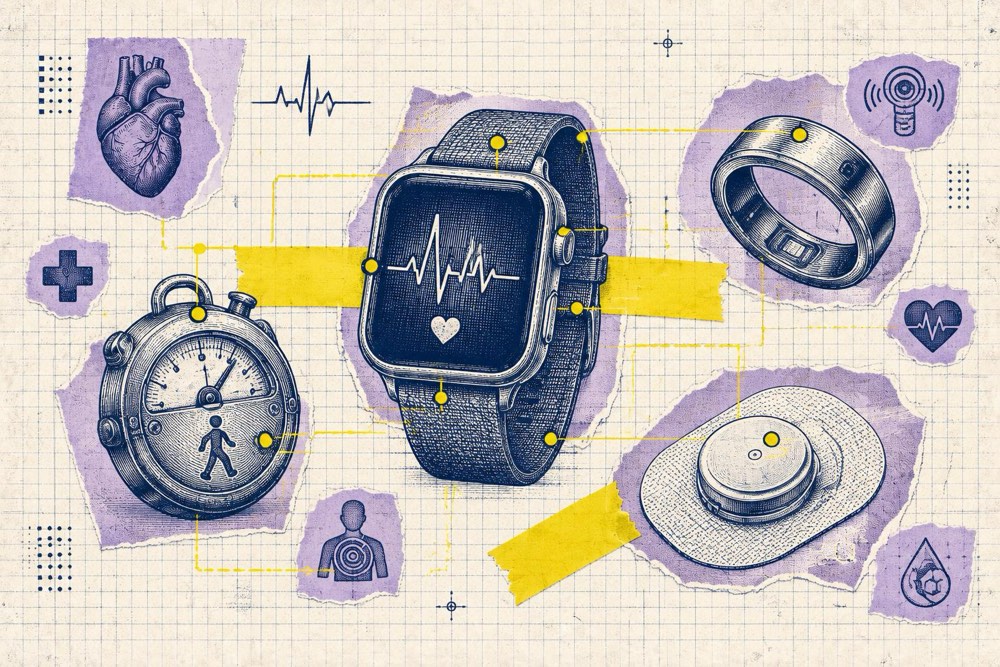
On 11 September 2018, the US Food and Drug Administration granted Apple two De Novo authorisations: one for an app that records an electrocardiogram from the Apple Watch, the other for a feature that flags an irregular pulse in the background. Apple presented both a day later at the launch of the Apple Watch Series 4. An electrocardiogram, or ECG, records the heart's electrical activity, an exam usually done in a clinic with electrodes on the chest.
Nine years earlier, the most advanced consumer health device on the market was a clip that counted steps. The French-language opening episode of Tech Anatomy's ERROR 404 summer series retraces how a wellness gadget became something a regulator treats as a medical device, and why the story does not end with the authorisation.
From the quantified self to a consumer market
In 2007, James Park and Eric Friedman founded a company in San Francisco, first called Healthy Metrics Research and soon renamed Fitbit. Their premise was that accelerometers, the motion sensors that smartphones had made small and cheap, could measure everyday physical activity. At the time, tracking one's own body was the hobby of a small community known as the quantified self.
The first Fitbit Tracker shipped in 2009. It counted steps, estimated calories and tracked sleep, but its novelty lay elsewhere: data left the device automatically and became charts, goals and rewards in an app. The same year, Withings, founded in 2008 near Paris, launched a bathroom scale that sent each weigh-in over Wi-Fi, followed later by a connected blood pressure monitor and an activity tracker.
None of this was medical, and nobody claimed otherwise. Fitbit went public in June 2015, raising around $732 million. The first Apple Watch shipped that same year, mainly as a smartwatch with fitness features.
What turns a gadget into a medical device
The dividing line is not the sensor but the claim. A product becomes a medical device when its maker says it diagnoses, monitors or treats a disease, and that claim has to be backed by clinical evidence and reviewed by a regulator.
De Novo is the FDA route for a new kind of low to moderate risk device that has no existing equivalent on the market. Apple was not the first company to put an FDA-cleared ECG on a wrist: AliveCor's KardiaBand, a strap with its own sensor, was cleared as an Apple Watch accessory in November 2017. Apple was the first to build the function into a mass-market watch itself.
What the Apple Heart Study measured
The second step was evidence at scale. The Apple Heart Study, run with Stanford and funded by Apple, enrolled 419,297 participants over eight months, entirely remotely. Its results were published in the New England Journal of Medicine in November 2019.
Over a median of 117 days, 0.52% of participants received an irregular pulse notification. Those notified were offered a telemedicine visit and an ECG patch to wear for up to a week. Among the 450 who returned a patch with analysable data, atrial fibrillation was found in 34%. Atrial fibrillation is a common rhythm disorder in which the heart beats irregularly, often without symptoms, and which raises the risk of stroke. When a notification and the patch recording overlapped, 84% of notifications matched atrial fibrillation on the ECG. Of 1,376 notified participants who answered a 90-day survey, 57% had contacted a health care provider.
Two sensors that measure different things
The pulse alert uses photoplethysmography: green light shines into the skin, and the amount reflected back changes slightly with each wave of blood, which lets the watch count beats and spot irregular intervals. The ECG app works differently. Touching the crown with a finger of the other hand closes an electrical circuit across the chest, and the watch records the voltage difference between the two points.
That recording is a single lead, one angle on the heart's electrical activity. A hospital ECG uses twelve. The FDA authorised the app to classify a tracing as atrial fibrillation or sinus rhythm, the normal rhythm, and its usefulness stops there.
A larger market, and a frontier that has moved
Google announced its plan to buy Fitbit in November 2019 and closed the $2.1 billion deal in January 2021, after a long review by competition authorities concerned about access to health data. IDC estimated that around 538 million wearable devices would ship worldwide in 2024, a count in which earbuds and other hearables, not watches, are the largest category.
The episode names two targets the industry is chasing: blood pressure without a cuff and glucose without a needle. On glucose, the FDA warned in February 2024 that it had not authorised any smartwatch or smart ring to measure blood glucose without piercing the skin, and that inaccurate readings could lead to dosing errors. On blood pressure, the picture has partly changed. In September 2025, Apple received FDA clearance for hypertension notifications, which analyse optical sensor data over 30-day periods and alert the user to consistent signs of high blood pressure. The feature does not measure blood pressure; Apple advises users who receive an alert to check with a cuff, and not everyone with hypertension will be notified.
Competing readings
One reading, the one the episode leans towards, treats this history as a steady move from wellness to medicine, built on two foundations: a regulatory authorisation and a large published study.
A second reading puts more weight on what the authorisations cover. They concern narrow, defined claims, such as classifying one rhythm on one lead or flagging a possible condition for confirmation elsewhere. In this view, the watch is becoming a triage device that sends people to conventional care, and its value depends on what that care does with the extra referrals.
Both readings fit the record. They differ on where the clinical value is created.
What the evidence does not establish
The Apple Heart Study measured whether notifications were accurate and whether people acted on them. It did not test whether screening a population with watches reduces strokes or deaths. In the episode's words (translated from French): "Detecting a signal and improving people's health are not the same thing." Participants were watch owners who volunteered and reported no prior atrial fibrillation, a group much younger on average than the people most at risk of the condition. Fewer than half of those notified returned a usable patch, and the patch was applied on average 13 days after the alert.
What to watch
The Heartline study, sponsored by Johnson & Johnson with Apple, randomised adults aged 65 and over to test whether earlier detection of atrial fibrillation reduces events such as stroke. Its registry entry lists it as completed in January 2025; results had not been posted there at the time of writing. The others are how hypertension notifications perform outside their validation study, how many alerts lead to a confirmed diagnosis and treatment, and the question the episode closes on: as watches measure more, who is expected to look at the data, the wearer, the physician or an algorithm.

Sources
- Tech Anatomy, ERROR 404: La folle histoire des objets connectés (in French), published 10 July 2026.
- Engineering the first Fitbit: the inside story, IEEE Spectrum
- Withings WiFi Body Scale integrates Twitter, launches in the US, Engadget, November 2009
- Redesigned Apple Watch Series 4 revolutionizes communication, fitness and health, Apple Newsroom, September 2018
- De Novo decision summary, ECG App, DEN180044, US Food and Drug Administration, September 2018
- De Novo database entry, Irregular Rhythm Notification Feature, DEN180042, US Food and Drug Administration, September 2018
- FDA clears AliveCor's KardiaBand as the first medical device accessory for the Apple Watch, TechCrunch, November 2017
- Perez MV, Mahaffey KW, Hedlin H, et al. Large-scale assessment of a smartwatch to identify atrial fibrillation. N Engl J Med. 2019;381:1909-1917.
- Google completes Fitbit acquisition, Google, January 2021
- Wearables to face continued growth while giving way to new form factors, IDC, December 2024
- Do not use smartwatches or smart rings to measure blood glucose levels: FDA safety communication, US Food and Drug Administration, February 2024
- Apple debuts Apple Watch Series 11, featuring groundbreaking health insights, Apple Newsroom, September 2025
- Apple Watch hypertension alerts feature receives FDA clearance, 9to5Mac, September 2025
- Next for Apple Watch: a pragmatic clinical trial with J&J to track heart health, STAT, March 2019
- Heartline study, NCT04276441, ClinicalTrials.gov